

Key Takeaways
- Florida business law protects companies from unfair competition, contract breaches, and partner disputes.
- Acting early saves time, money, and business relationships.
- An experienced business attorney helps you assess risk and choose the right legal strategy.
What if the biggest obstacle to recovering your construction investment isn’t the contractor’s disappearance, but a single missed deadline in a pre-suit notice? As a legal guide and a fellow business owner, I understand the frustration of watching your operations stall while an empty job site drains your capital. When you are considering suing a contractor for non-performance florida law requires you to navigate a specific statutory minefield long before you ever reach a courtroom. It’s a high-stakes environment where procedural diligence is just as critical as the underlying contract dispute.
You deserve a resolution that protects your investment and allows your company to move forward. This guide provides the exact legal steps, Florida-specific statutes, and evidentiary requirements necessary to hold a non-performing party accountable. We will preview the mandatory Chapter 558 notice process, the shortened seven-year statute of repose, and the path to recovering damages through civil litigation. By handling these complex technicalities, we aim to safeguard your interests and allow you to return your focus to your core business operations and professional passions.
Key Takeaways
- Identify the legal distinction between minor delays and a material breach to determine if your project qualifies for a total breach claim.
- Master the mandatory pre-suit notice requirements under Florida Statute Chapter 558 to avoid immediate delays when suing a contractor for non-performance florida.
- Discover the four essential elements required to prove a construction dispute and how to document the paper trail that supports your recovery.
- Learn why conducting a comprehensive project audit and issuing a formal Notice to Cure are vital steps to safeguard your investment before entering a courtroom.
- Understand how experienced civil litigation support helps you navigate complex local court systems while you focus on your company’s core operations.
Understanding Contractor Non-Performance Under Florida Law
Florida law distinguishes between a contractor who does a poor job and one who simply stops working. When you are considering suing a contractor for non-performance florida statutes and case law provide specific frameworks to determine if the failure constitutes a breach of contract. A material breach occurs when the failure goes to the very heart of the agreement, rendering the remaining performance effectively useless to the owner. This is not merely about a few missing fixtures; it is about the fundamental collapse of the professional agreement.
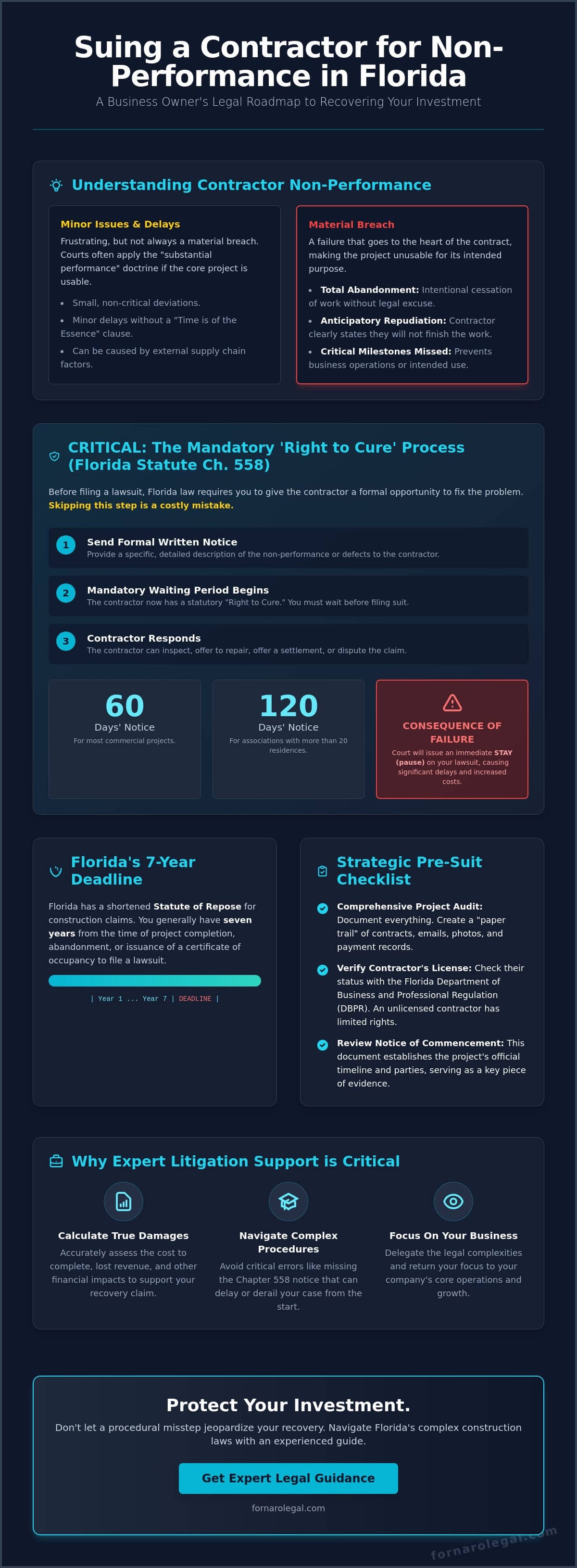
In 2026, courts continue to weigh the doctrine of “substantial performance” heavily. This principle protects contractors who have completed the vast majority of the project with only minor, non-critical deviations. However, if unfinished milestones prevent your business from opening or utilizing the space for its intended purpose, the performance is not substantial. You may also encounter “anticipatory repudiation.” This happens when a contractor explicitly states or clearly demonstrates through their actions that they will not fulfill their remaining obligations, allowing you to seek legal remedies before the actual deadline arrives.
Total Abandonment vs. Chronic Delays
Abandonment is more than just a missed week of work. In Florida commercial construction, abandonment is typically defined as a contractor’s intentional cessation of work for a significant period without a legal excuse or the owner’s consent. While chronic delays are frustrating, they only cross into a material breach if the contract includes a “Time is of the Essence” clause or if the delays are so egregious they frustrate the entire purpose of the agreement. The process of suing a contractor for non-performance florida requires a deep dive into these definitions. Given the 2026 labor market conditions, where skilled trades remain in high demand, Florida courts are carefully scrutinizing whether delays are within the contractor’s control or are truly unavoidable due to external supply chain factors.
The Role of the Notice of Commencement
Your legal standing often begins with the documents you filed before the first brick was laid. The original Notice of Commencement defines the timeline and the parties involved, serving as a baseline for performance expectations. Before initiating a claim, it’s vital to verify the contractor’s licensing through the Department of Business and Professional Regulation (DBPR). If a contractor is unlicensed, they may be barred from enforcing a contract or filing a lien against your property. Protecting yourself from fraudulent construction liens is a priority during a dispute; an experienced legal guide can help you contest these liens while you pursue a resolution for non-performance. This allows you to delegate the complex technicalities and return your focus to your company’s growth.
The Legal Framework: Florida Statute Chapter 558 and the Right to Cure
Florida’s legal system prioritizes the resolution of construction conflicts through a mandatory pre-suit process known as the “Right to Cure.” Before you can proceed with suing a contractor for non-performance florida law mandates that you follow the procedures in Florida Statute Chapter 558. This statute acts as a gatekeeper, requiring property owners to provide contractors with a formal notice of the alleged defects or performance failures before a lawsuit is even filed. It’s a procedural hurdle designed to encourage settlements, but for an unprepared business owner, it can become a significant roadblock.
Skipping this notice period is a critical mistake. If you file a lawsuit without adhering to the Chapter 558 process, the court will likely issue an immediate stay of your case. This pause remains in effect until you comply with the statutory requirements, effectively delaying your path to recovery and increasing your legal costs. In 2026, the courts remain strict about these timelines. For most commercial projects, you must provide the contractor with written notice at least 60 days before filing your claim. If the dispute involves an association with more than 20 residences, that notice period extends to 120 days.
Navigating the Pre-Suit Notice Process
A valid notice must be specific. You cannot simply state that the work is “unfinished” or “poor.” You must describe the non-performance or defects in enough detail for the contractor to understand the nature of the claim. Once the notice is served, the contractor has a 30-day window to inspect the property. Following the inspection, they have a total of 45 days from the initial notice to provide a written response. This response generally takes one of three forms: an offer to repair the issue, a monetary settlement offer, or a complete denial of the claim. Use this period as a leverage tool. It’s often the best time to engage in mediation and resolve contract disputes before the expenses of a full trial begin to mount.
Express vs. Implied Warranties
Your legal strategy should also account for the various warranties protecting your project. Express warranties are the specific guarantees written into your construction agreement, such as deadlines and material standards. However, Florida also recognizes implied warranties of fitness and merchantability. These protect you by asserting that the construction must be fit for its intended purpose, even if the contract doesn’t explicitly state every detail. Be mindful of oral modifications. While contractors often make verbal promises on-site, these are notoriously difficult to enforce without a written “change order” or email confirmation. Safeguarding your investment requires a diligent approach to both the written contract and the statutory notice requirements.
Proving Your Case: Burden of Proof and Calculating Damages
Establishing a successful claim requires more than just showing an empty job site. When you are suing a contractor for non-performance florida courts require you to prove four essential elements. First, you must show a valid contract existed. Second, you must demonstrate a material breach occurred. Third, you must prove you fulfilled your own contractual obligations, such as making timely payments. Finally, you must show that the breach resulted in actual financial loss. Without these four pillars, your case may struggle to survive a motion to dismiss.
A robust “paper trail” is your strongest asset in any construction dispute. This documentation should include every email, daily job log, and payment record associated with the project. In the commercial world, these records transform a “he-said, she-said” dispute into a factual narrative that a judge or arbitrator can follow. You’ll also likely need expert witness testimony to meet your burden of proof. A third-party contractor or structural engineer can provide the technical authority needed to validate that the work performed, or lack thereof, fell below industry standards. Attempting to prove these technical failures without professional testimony often leads to insufficient evidence at trial.
Managing these evidentiary requirements is an exhaustive process for any business owner. By delegating this complex proof to an experienced litigator, you protect your company from procedural errors and ensure your case is built on a solid foundation. This allows you to return to your core passions and professional growth while your legal advocate handles the technicalities of the litigation and the pursuit of your investment recovery.
Types of Recoverable Damages in Florida
Florida law allows for several types of financial recovery. Compensatory damages typically cover the cost of hiring a new firm to complete the project or repair defective work. If your agreement included liquidated damages, you might be able to enforce per-day penalties for every day the project remained stalled past the deadline. Consequential damages, which cover lost business profits due to the delay, are also possible if they were foreseeable at the time you signed the contract. Recovering these damages ensures your business is placed in the position it would’ve been in had the contractor performed as promised.
The “Benefit of the Bargain” Rule
Florida courts often apply the “benefit of the bargain” rule when calculating awards. This calculation measures the difference between the original contract price and the actual cost you incurred to complete the project as promised. It’s important to remember your duty to mitigate losses. You must take reasonable steps to prevent further damage, such as securing the site against weather or preventing further deterioration. Regarding legal costs, you can typically only recover attorney fees if your contract specifically allows for it or if a particular Florida statute applies to your situation. Proving these damages accurately is vital for a full financial recovery.
Strategic Steps to Take Before Filing Your Lawsuit
Preparation is the silent engine of a successful legal recovery. Before you commit to the formal process of suing a contractor for non-performance florida courts expect you to have exhausted specific administrative and contractual avenues. Think of this phase as building the fortress that will protect your investment during the coming litigation. You must start with a comprehensive audit of every scrap of project documentation, from the initial bid to the last text message exchanged with a project manager. This data forms the backbone of your narrative.
Next, you should issue a formal “Notice to Cure.” While this sounds similar to the Chapter 558 notice discussed earlier, it’s often a distinct requirement within your specific contract that gives the contractor one final chance to fix the issue before they’re considered in default. Simultaneously, you must document the current state of the job site using high-resolution video and photos. This visual evidence freezes the scene in time, preventing the contractor from claiming they did more work than they actually completed. You also need to verify the status of their performance bond and liability insurance, as these are the financial safety nets that often pay out when the contractor’s bank accounts are empty. Finally, consulting with a business litigation lawyer to draft the complaint ensures your strategy is sound from day one.
Auditing Your Construction Agreement
Your contract is the rulebook for your dispute. Look closely for mandatory arbitration or mediation clauses; these can strip away your right to a jury trial and force you into a private forum. You also need to identify any “No Damage for Delay” clauses. These are common in Florida and can significantly limit your ability to recover financial losses caused by a stalled timeline. Ensure that every change order was executed in writing, as verbal agreements are rarely enough to overcome a well-drafted contract in a South Florida courtroom. Our goal is to handle these complex technicalities so you can return to your core passions and professional growth.
The Role of the DBPR and Licensing Boards
Filing a formal complaint with the Florida Department of Business and Professional Regulation (DBPR) serves a dual purpose. It initiates a regulatory review that can lead to contractor discipline, but it also provides significant leverage in your civil lawsuit. A contractor facing the loss of their license is often more motivated to reach a settlement. Additionally, we recommend verifying if the contractor has other pending litigation in Broward or Miami-Dade. This research reveals if you’re dealing with a one-time failure or a pattern of professional negligence. Identifying these patterns early allows us to build a more aggressive case for your recovery. If you’re ready to protect your business interests, contact us to discuss your civil litigation options today.
Why Expert Litigation Support is Critical for Florida Business Owners
Attempting “pro se” litigation in a complex construction dispute is a gamble that few commercial entities can afford. While your entrepreneurial instincts might suggest you can handle the negotiation, the procedural maze of the Florida court system is unforgiving. When you’re suing a contractor for non-performance florida judges expect strict adherence to the Florida Rules of Civil Procedure. A single filing error in Broward or Miami-Dade can lead to a dismissal with prejudice, permanently barring your recovery. As a fellow business owner, I recognize that your time is your most valuable asset. Navigating these local court systems requires an authoritative guide who understands both the technical law and the commercial realities you face every day.
The Matthew Fornaro, P.A. advantage provides a protective shield, allowing you to project a position of strength without sacrificing your focus on company growth. By positioning the firm as both a legal expert and a peer to other entrepreneurs, we ensure your commercial reputation remains intact during public disputes. Litigation isn’t just about winning a judgment; it’s about safeguarding the professional ecosystem you’ve worked decades to build. We act as a seasoned guide, helping you avoid the pitfalls that often trap those who attempt to navigate these systems alone.
Mediation and Arbitration Alternatives
Not every dispute needs to end in a courtroom. In many cases, mediation offers the fastest path to project completion. It allows for creative settlements that a judge cannot order, such as structured payment releases tied to specific milestones or the involvement of a third-party consultant to oversee the final phase. Conversely, binding arbitration can be more efficient than a jury trial, though it often limits your rights to appeal. We help you weigh these pros and cons based on the specific language in your original agreement, ensuring the final resolution actually results in a finished project rather than just an empty judgment.
Safeguarding Your Operations
The core value of professional representation is the freedom it provides. Our “Focus” benefit means we handle the technicalities of contract disputes while you return to your core passions and professional growth. We approach every case with a resolution-first mindset, seeking the most direct path to making your business whole again. Whether through aggressive civil litigation or strategic negotiation, our goal is to protect your commercial investment in South Florida. If you’re ready to hold a non-performing party accountable and shield your operations from further risk, Matthew Fornaro, P.A. is here to provide the dependable, authoritative guidance you need to move forward.
Secure Your Commercial Future in South Florida
Resolving a construction dispute requires a delicate balance of procedural precision and commercial strategy. You’ve seen that navigating Florida Statute Chapter 558 is not optional; it’s a mandatory prerequisite to protecting your legal rights. By maintaining a meticulous paper trail and understanding the “benefit of the bargain” rule, you position your company to recover lost investment and minimize operational downtime. When you are considering suing a contractor for non-performance florida law demands a level of diligence that can overwhelm even the most seasoned entrepreneur.
Matthew Fornaro, P.A. brings over 20 years of business litigation experience to your case. As a firm led by a dedicated attorney and a fellow business owner deeply integrated into the Coral Springs and South Florida community, we understand the high stakes of your commercial projects. We handle the complex technicalities of your claim so you can return your focus to your core passions and the growth of your enterprise. You don’t have to navigate these complex systems alone. Protect your business investment and consult with Matthew Fornaro, P.A. today. We look forward to helping you secure the resolution your business deserves.
Frequently Asked Questions
Can I fire my contractor for being late in Florida?
You can terminate a contractor for delays only if the timeline was a material term of the agreement or if the contract includes a “Time is of the Essence” clause. If the delay is minor and doesn’t fundamentally frustrate the project’s purpose, firing them might be viewed as a wrongful termination. It’s vital to review your contract’s default provisions and provide proper notice before officially severing the professional relationship.
What is the statute of limitations for suing a contractor in Florida?
For a lawsuit based on a written contract, the deadline is five years from the date of the breach. If you’re dealing with an oral agreement, the deadline is four years. In cases involving construction defects, you must file within four years of discovery, but Florida law also imposes an absolute seven-year statute of repose that cuts off all claims regardless of when you found the defect.
Do I have to give my contractor a chance to fix the work before suing?
Yes, Florida Statute Chapter 558 requires you to provide a written notice of the alleged defects or non-performance at least 60 days before filing a lawsuit. This “Right to Cure” law gives the contractor a mandatory window to inspect the property and offer a repair or a monetary settlement. When you’re suing a contractor for non-performance florida courts will stay your case if you haven’t completed this pre-suit process.
Can I sue a contractor without a written contract in Florida?
You can sue based on an oral contract, though proving the specific terms of the agreement is significantly more difficult. You’ll need to rely on a paper trail of emails, text messages, bank statements, and witness testimony to establish the scope of work and payment terms. Keep in mind that oral contracts have a shorter four-year statute of limitations, making it critical to act quickly to preserve your rights.
What happens if a contractor files a lien after I sue them for non-performance?
You can contest the lien by filing a formal “Notice of Contest of Lien,” which shortens the contractor’s window to file a foreclosure suit to 60 days. If the contractor hasn’t performed the work or filed the lien in bad faith, you may be able to have it dismissed as a fraudulent lien. This protective measure ensures your property title remains clear while the underlying litigation moves through the court system.
How much does it cost to sue a contractor for breach of contract in Florida?
Total costs depend on court filing fees, the need for expert witnesses like structural engineers, and the length of the litigation. While we don’t quote specific legal fees, many Florida construction contracts include a “prevailing party” clause. This provision allows the successful party in a lawsuit to recover their reasonable attorney fees and costs from the losing party, which can significantly offset the financial burden of the dispute.
Can I recover lost business revenue if a contractor abandons my project?
You can recover consequential damages for lost profits if you can prove the losses were a foreseeable result of the abandonment at the time of signing. You’ll need to provide concrete financial evidence, such as year-over-year profit comparisons or lost rental income, to support your claim. Courts won’t award damages based on speculation, so having a litigator audit your financial records is essential for a successful recovery.
What is a Chapter 558 notice and is it required for non-performance?
A Chapter 558 notice is a mandatory pre-suit document that outlines specific construction defects or performance failures to the contractor. It’s a foundational requirement for suing a contractor for non-performance florida because it facilitates a “right to cure” period. This process is designed to encourage a resolution through repair or settlement before the parties incur the significant expenses associated with a full civil trial in South Florida.


