

Key Takeaways
- Florida business law protects companies from unfair competition, contract breaches, and partner disputes.
- Acting early saves time, money, and business relationships.
- An experienced business attorney helps you assess risk and choose the right legal strategy.
Table of Contents
- Is a 50/50 Partnership a Good Idea in Florida? Pros and Cons
- Step 1: Choose the Right Business Entity for Equal Ownership
- Step 2: Use a Florida Partnership Agreement Template as Your Foundation
- Step 3: Define Roles, Responsibilities, and Decision-Making Authority
- Step 4: Build Business Deadlock Resolution Clauses Into Your Agreement
- Step 5: Draft a Buy-Sell Agreement in Florida to Protect Both Partners
- How to Structure a 50/50 Business Partnership in Florida: Common Mistakes to Avoid
- Dissolving a Business Partnership in Florida: What You Need to Know
Last Updated: June 17, 2026
Equal ownership sounds fair on paper. In practice, a 50/50 split is one of the most legally precarious structures a Florida business can adopt, and most partners discover that only after a dispute has already started. Understanding how to structure a 50 50 business partnership in Florida correctly, before you sign anything, is the difference between a business that thrives and one that ends in litigation. At Matthew Fornaro, P.A., we have spent over two decades helping Coral Springs entrepreneurs and South Florida small business owners build partnership structures that actually hold up. Below, we walk through every critical step, from choosing your entity to drafting deadlock resolution clauses, so you can protect your investment from day one.
A 50/50 partnership is a business ownership arrangement where two partners hold equal equity, equal voting rights, and equal decision-making authority. That symmetry is both its appeal and its fundamental risk.
Is a 50/50 Partnership a Good Idea in Florida? Pros and Cons
The honest answer is: it depends entirely on how well you structure it. Equal ownership appeals to partners who want to signal mutual commitment, but without the right legal framework, that equality becomes a structural flaw.
Pros of a 50/50 Ownership Structure
- Both partners have equal skin in the game, which aligns incentives
- Neither partner can unilaterally override the other on major decisions
- Profit sharing is straightforward and perceived as fair
- Equal equity contributions often simplify capital contribution negotiations
Cons of a 50/50 Ownership Structure
- Every significant disagreement has the potential to become a deadlock
- Florida courts have limited tools to resolve internal business disputes without dissolution
- Fiduciary duty obligations apply equally, which creates friction when partners disagree on strategy
- Lenders and investors sometimes view equal ownership as a governance risk
The real danger is not the split itself, it is the absence of a mechanism to break an impasse. According to Florida Division of Corporations business formation guidance, thousands of new business entities are formed in Florida each year, yet many lack the foundational agreements that would protect them during disputes. Partners who succeed with equal ownership treat the partnership agreement as a governance document, not just a formality.
Step 1: Choose the Right Business Entity for Equal Ownership
Most people assume a 50/50 partnership automatically means forming a general partnership. That assumption costs businesses significantly in both liability exposure and tax efficiency.
General Partnership vs. LLC: What Florida Law Says
A general partnership under Florida Statutes Chapter 620 requires no formal filing, which sounds convenient but creates serious problems: both partners bear unlimited personal liability for business debts and the actions of their co-partner.
A Florida LLC with two equal members is almost always the better structure. It provides limited liability protection, allows the operating agreement to override Florida’s default rules, and gives partners far more flexibility in defining management authority, financial distributions, and exit strategies. A general partnership exposes your personal assets; a properly drafted LLC does not.
Tax Implications of a 50/50 Ownership Structure
A 50/50 LLC is treated as a partnership for federal tax purposes by default, profits and losses pass through to each partner’s individual return in equal shares, and both partners pay self-employment taxes on their distributive share. If one partner is more active in operations, this equal tax burden can become a point of friction. A well-drafted operating agreement can address guaranteed payments to active partners, separating compensation from profit distributions. Consult a tax professional familiar with Florida business law to structure distributions appropriately.
Step 2: Use a Florida Partnership Agreement Template as Your Foundation
A Florida partnership agreement template is a starting point, not a finished product. The biggest mistake equal-ownership partners make is downloading a generic template and treating it as sufficient. Every clause needs to reflect your specific business, your specific roles, and your specific plan for what happens when things go wrong.
s sitting across a desk from an attorney reviewing and signing legal documents in a professional law office setting, with natural window light and organized files on the desk](https://cdn.grandranker.com/articles/how-to-structure-a-5050-business-partnership-in-florida-content-1-1781661185.jpg)
The agreement should be drafted or reviewed by a Florida business lawyer who understands both the statutory framework and the practical realities of equal-ownership disputes. A template gives you the structure. An attorney gives you the substance.
Key Clauses Every Florida Partnership Agreement Must Include
A comprehensive Florida partnership agreement for a 50/50 structure must address the following:
- Capital contributions – How much each partner contributes initially, and the process for future capital calls
- Profit and loss distribution – Whether distributions are equal, tied to performance, or subject to guaranteed payments
- Decision-making authority – Which decisions require unanimous consent versus majority vote (in a 50/50 structure, this distinction matters enormously)
- Roles and responsibilities – Specific operational domains each partner controls independently
- Deadlock resolution – The exact mechanism triggered when partners cannot agree
- Buy-sell provisions – What happens when one partner wants out or dies
- Non-compete and non-solicitation – Protecting the business if the partnership dissolves
- Dissolution procedures – The process for winding down the business if necessary
According to Florida Statutes Chapter 605 governing LLCs, operating agreements can modify nearly all default statutory rules for Florida LLCs, which is precisely why getting the agreement right matters so much.
Step 3: Define Roles, Responsibilities, and Decision-Making Authority
Here is where most 50/50 partnerships fail, not in the legal documents, but in the operational reality. Partners who each believe they have equal authority over everything will eventually collide.
Operational Governance Models That Prevent Conflict
The most effective approach is domain-based governance: each partner is assigned clear operational domains where their decision is final without requiring the other’s approval.
The Functional Split Model: Partner A controls all financial decisions, vendor relationships, and back-office operations. Partner B controls all client relationships, sales, and product development. Both partners must approve hiring, capital expenditures above a threshold, and strategic pivots.
The Tier-Based Model: Tier 1 decisions (daily operations under $5,000) require one partner. Tier 2 decisions ($5,000-$50,000 or new contracts) require both partners. Tier 3 decisions (equity changes, real estate, major debt) require both partners plus a defined waiting period.
The operational governance model must be written directly into the operating agreement. Verbal agreements between business partners are nearly impossible to enforce in Florida courts once a dispute arises.
Step 4: Build Business Deadlock Resolution Clauses Into Your Agreement
Business deadlock resolution clauses are contractual provisions that define the specific steps partners must follow when they cannot reach a decision. Without them, a deadlock in a 50/50 Florida business can only be resolved through costly litigation or dissolution. This is the most critical section of any equal-ownership agreement, and the one most frequently omitted from generic templates.
Tie-Breaker Mechanisms That Work in Practice
Designated Tiebreaker: Partners appoint a neutral third party, often a trusted advisor, accountant, or industry expert, whose vote breaks the tie on specific categories of decisions.
Russian Roulette (Shotgun Clause): One partner names a buyout price; the other must either buy at that price or sell at that price. Decisive, but can disadvantage the partner with less liquidity.
Escalation Ladder: Partners first attempt direct negotiation, then mediation, then arbitration, before any court involvement. This is the most commonly recommended structure for Florida businesses because it keeps disputes private and cost-controlled.
The right mechanism depends on the nature of your business and the relationship between partners. A Florida business lawyer can help you select the combination that fits your situation.
Mediation and Arbitration Under Florida Business Law
Florida strongly favors alternative dispute resolution. The Florida Dispute Resolution Center under the Florida Supreme Court oversees a network of certified mediators, and Florida courts regularly require mediation before allowing business disputes to proceed to trial.
Building mandatory mediation and arbitration clauses into the operating agreement keeps disputes private, resolves them faster, and costs substantially less than court proceedings. Arbitration under the American Arbitration Association’s commercial rules is a common choice, as the rules are well-established and business-experienced arbitrators are readily available.
Step 5: Draft a Buy-Sell Agreement in Florida to Protect Both Partners
A buy-sell agreement in Florida is a legally binding contract governing what happens to a partner’s ownership interest when a triggering event occurs, death, disability, divorce, bankruptcy, or a desire to exit. Without one, the departure of one partner can force the remaining partner to either dissolve the business or accept an unknown new co-owner, such as a deceased partner’s heir.
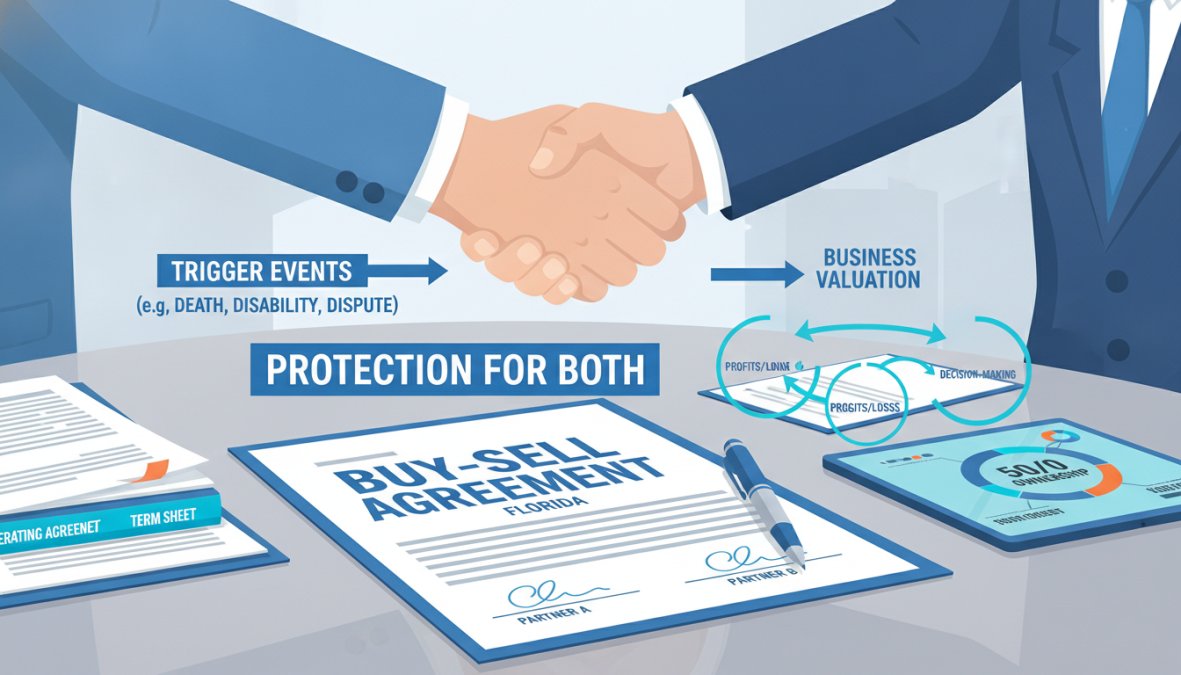
A Florida buy-sell agreement should address:
- Triggering events – Death, disability, voluntary withdrawal, bankruptcy, divorce, or criminal conviction
- Valuation method – Fixed price, formula-based, or third-party appraisal
- Funding mechanism – Life insurance, installment payments, or a business line of credit
- Right of first refusal – The remaining partner’s right to purchase before the interest is offered externally
- Transfer restrictions – Preventing a partner from selling their interest to a competitor or unknown third party
The valuation method deserves particular attention. Many buy-sell agreements use a fixed price set at signing, which quickly becomes outdated as the business grows. A formula-based approach tied to annual revenue or EBITDA tends to produce fairer results. According to American Bar Association guidance on buy-sell agreements, valuation disputes are among the most common sources of litigation in closely held business buyouts. Matthew Fornaro, P.A. regularly assists Coral Springs and Broward County business owners in drafting buy-sell agreements that anticipate these scenarios and close the gaps that generic templates leave open.
How to Structure a 50/50 Business Partnership in Florida: Common Mistakes to Avoid
Knowing how to structure a 50 50 business partnership in Florida is partly about doing the right things and partly about avoiding the predictable errors that derail equal-ownership businesses.
| Common Mistake | Why It Happens | The Fix |
|---|---|---|
| No written agreement | Partners trust each other initially | Draft a full operating agreement before operations begin |
| Vague decision-making authority | Partners avoid the uncomfortable conversation | Use domain-based governance with written thresholds |
| No deadlock clause | Generic templates omit it | Add a tiered escalation clause with mediation and arbitration |
| Outdated buy-sell valuation | Fixed price set at formation | Use a formula-based or annual appraisal method |
| No exit timeline | Partners assume the business will last forever | Define exit windows and notice requirements in the agreement |
| Mixing personal and business finances | Common in early-stage businesses | Maintain separate accounts; document all capital contributions |
The agreement is not a sign of distrust. It is the operational manual for your partnership, and the absence of a structure for handling disagreement is what causes most failures, not the split itself.
Dissolving a Business Partnership in Florida: What You Need to Know
Dissolving a business partnership in Florida is a formal legal process, not simply a handshake agreement to stop operating. Getting it wrong exposes both partners to ongoing liability.
Under Florida Statutes, dissolving an LLC requires filing Articles of Dissolution with the Florida Division of Corporations, settling all outstanding debts, distributing remaining assets according to the operating agreement, and notifying creditors and counterparties. General partnership dissolution under Florida’s Uniform Partnership Act requires winding up business affairs, liquidating assets, and paying creditors before distributing remaining value to partners.
A few practical realities worth knowing:
- Dissolution does not automatically terminate existing contracts, the business remains liable until each contract is formally addressed.
- Partners remain personally liable for pre-dissolution debts in a general partnership even after dissolution is filed.
- Tax obligations survive dissolution: final tax returns must be filed and the IRS notified that the entity has terminated.
Building dissolution procedures into the original agreement, when everyone is still aligned, produces far better outcomes than negotiating them during a dispute. For Coral Springs and Broward County business owners, working with a local attorney who knows Florida business law is the most direct path to a resolution that protects both parties.
Structuring a 50/50 business partnership correctly requires more than splitting ownership down the middle. It requires a governing document that addresses deadlock, exit rights, valuation, and operational authority before any of those issues become urgent. Matthew Fornaro, P.A. has spent over two decades helping South Florida entrepreneurs build business structures that hold up under pressure, with comprehensive support in business formation, contracts, and commercial litigation. If you are forming or restructuring a partnership in Coral Springs or anywhere in Broward County, call Matthew Fornaro, P.A. today to protect your business interests from the start.
Frequently Asked Questions
What are the risks of a 50/50 business partnership in Florida?
The biggest risk in a 50/50 partnership is deadlock, when equal partners cannot agree on a major business decision and neither has the authority to break the tie. Without a written partnership agreement that includes dispute resolution mechanisms, Florida courts may have limited options short of ordering dissolution. Equal ownership also means equal liability exposure in a general partnership, making proper business entity selection and a well-drafted operating agreement essential to protecting both partners.
Is a written partnership agreement required in Florida?
Florida does not legally require a written partnership agreement, but operating without one is a serious risk. Under the Florida Revised Uniform Partnership Act, default rules will govern your business if no written agreement exists, and those defaults may not reflect your intentions. For example, profits and losses are split equally by default regardless of capital contributions or workload. A written agreement drafted by a Florida business lawyer gives both partners enforceable protections and clear governance rules.
How do you resolve a deadlock in a 50/50 partnership in Florida?
The most effective way to resolve a deadlock is to plan for it before it happens. A well-structured Florida partnership agreement or LLC operating agreement should include business deadlock resolution clauses such as mandatory mediation, binding arbitration, a designated neutral tie-breaker, or a Russian roulette buy-sell provision. If no such clauses exist and partners cannot reach agreement, litigation or court-ordered dissolution may become the only options, which are costly and damaging to the business.
Can one partner force another out of a 50/50 business in Florida?
Generally, one partner cannot unilaterally force out another in a 50/50 structure without a contractual mechanism in place. This is why a buy-sell agreement in Florida is critical. A properly drafted buy-sell agreement sets out the triggering events, valuation methods, and purchase terms that allow one partner to buy out the other under defined circumstances. Without this, removing a partner typically requires mutual agreement, mediation, arbitration, or court intervention under Florida business law.
What happens if there is no partnership agreement in a Florida business?
Without a partnership agreement, Florida's default statutory rules under the Florida Revised Uniform Partnership Act apply. This means equal profit sharing regardless of unequal contributions, equal decision-making authority with no tie-breaker, and each partner having full authority to bind the business. There are also no agreed exit strategies or dissolution procedures, leaving partners exposed to costly litigation if the relationship breaks down. A business lawyer in Coral Springs or Broward County can help you avoid these risks.
This article was written using GrandRanker


