

Key Takeaways
- Florida business law protects companies from unfair competition, contract breaches, and partner disputes.
- Acting early saves time, money, and business relationships.
- An experienced business attorney helps you assess risk and choose the right legal strategy.
A class action lawsuit is defined as a legal proceeding where one or more named plaintiffs sue a defendant on behalf of a larger group of people who suffered the same or similar harm. This collective approach exists because judicial efficiency demands it. When thousands of consumers buy the same defective product or fall victim to the same fraudulent billing practice, forcing each person to file a separate lawsuit wastes court resources and prices most victims out of the legal system entirely. Federal Rule of Civil Procedure 23 governs how these cases proceed in U.S. federal courts, setting the certification standards every class action must clear before moving forward. Cases like Tobacco Litigation, the Volkswagen emissions scandal, and the Equifax data breach settlement show how class actions can deliver accountability at a scale no individual lawsuit could match.
What is a class action lawsuit and how does it get certified?
Class action lawsuit eligibility starts with a court’s decision to certify the case. Certification is the most critical hurdle, requiring courts to rigorously analyze numerosity, commonality, typicality, and adequacy before allowing a case to proceed. Without certification, the lawsuit proceeds as an ordinary individual claim.
Courts apply a four-part test under Rule 23(a):
- Numerosity. The class must be large enough that joining every member individually would be impractical. At least 40 harmed individuals is the widely accepted benchmark, though courts have discretion.
- Commonality. The claims must share at least one common legal question or factual issue. A data breach affecting 500,000 customers who all used the same platform satisfies this easily.
- Typicality. The named plaintiff’s claims must be typical of the broader class. If the lead plaintiff suffered a unique injury not shared by others, typicality fails.
- Adequacy. The named plaintiff and their attorney must be capable of fairly representing the entire class without conflicts of interest.
Under Rule 23(b)(3), courts also require that common questions predominate over individual ones, and that a class action is superior to other methods of resolving the dispute. This is where many cases fail. If each class member’s damages require a separate factual inquiry, courts will deny certification.
Pro Tip: If you believe you qualify as a class member, document your harm early. Courts scrutinize the named plaintiff’s records during certification, and weak documentation can derail the entire case.

How does the class action process work from filing to settlement?
Understanding how class action lawsuits work requires following the case through several distinct phases. Each phase has real consequences for what you receive and when.
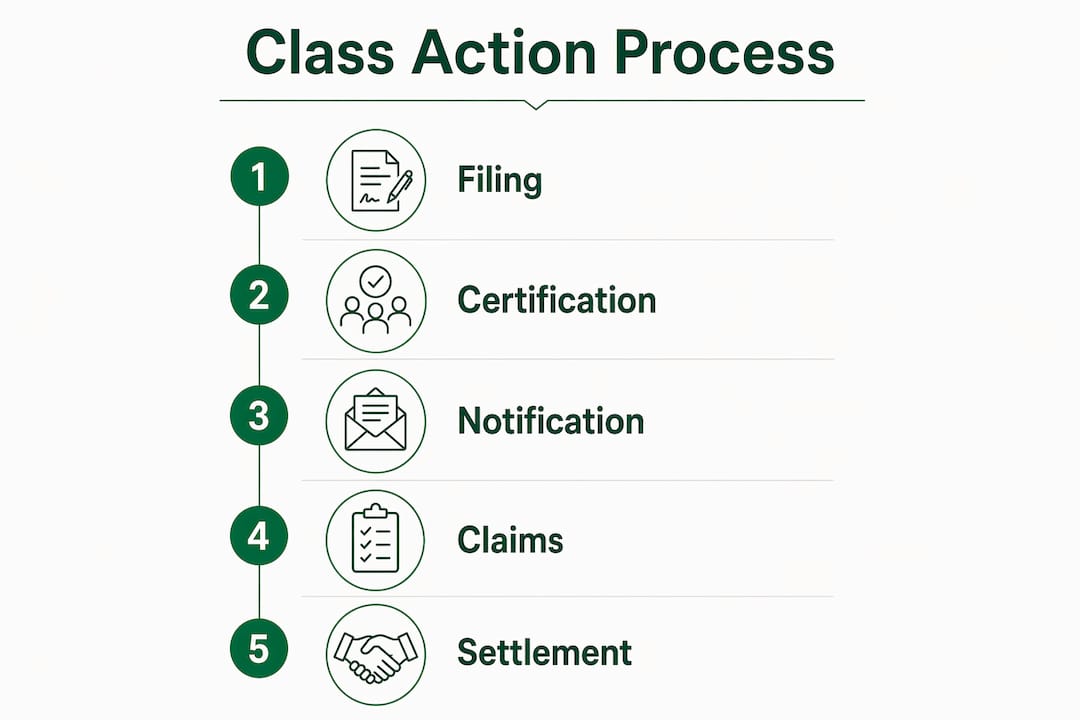
- Filing the complaint. One or more named plaintiffs file a complaint in federal or state court, identifying the defendant, the harm, and the proposed class definition.
- Motion for class certification. Plaintiffs’ attorneys file a motion asking the court to certify the class. The court conducts a rigorous analysis at this stage, not just a preliminary review.
- Discovery. Both sides exchange evidence. In class actions, discovery focuses on issues common to the entire class, such as the defendant’s internal communications, product testing records, or billing systems.
- Settlement negotiations or trial. Most certified class actions settle before trial, with court-supervised negotiations determining compensation terms.
- Judicial approval of settlement. Under Rule 23(e), all proposed settlements must receive court approval as fair, reasonable, and adequate before they are finalized.
- Claims filing and distribution. Class members receive notice and must file claims within a set window to receive payment.
The claims filing deadline is where many eligible people lose their compensation. The claims filing window typically lasts 60–120 days from the notice date. Missing that deadline means no payout, even if you are a fully qualified class member.
| Phase | What Happens | Your Role |
|---|---|---|
| Filing | Complaint filed by named plaintiff | None yet |
| Certification | Court evaluates class eligibility | Provide documentation if named |
| Discovery | Evidence exchange on common issues | Minimal for most members |
| Settlement | Court-supervised negotiation | Review notice carefully |
| Claims filing | Submit claim form within deadline | Act within 60–120 days |
Pro Tip: Set a calendar reminder the day you receive a class action notice. The 60–120 day window closes faster than most people expect, and there are no extensions for missing it.
What are the benefits and risks of joining a class action?
The benefits of class action lawsuits are real, but so are the trade-offs. Knowing both sides helps you decide whether joining or opting out serves your interests better.
Benefits:
- Access to justice. Class actions enable individuals with small individual damages to pursue claims that would be economically impossible to litigate alone. A $50 overcharge is not worth a solo lawsuit. Combined with 200,000 other victims, it becomes a $10 million case.
- Cost efficiency. Legal fees are shared across the class, so individual members pay nothing out of pocket. Attorneys work on contingency, taking a percentage of the final settlement.
- Collective leverage. Corporations respond differently to a class of 100,000 plaintiffs than to a single complainant. The threat of a large judgment changes negotiating dynamics.
- Precedent and accountability. A successful class action can force a company to change its practices, benefiting people who were never even part of the lawsuit.
Risks:
- Smaller individual payouts. Settlement funds are divided among all class members. In large classes, individual checks can be surprisingly small, sometimes just a few dollars.
- Loss of individual rights. Class actions bind all members who do not opt out, preventing separate individual lawsuits for the same claims after judgment. If you stay in the class and the settlement is inadequate, you cannot sue again.
- Unequal distribution. Settlement funds are rarely divided evenly. Lead plaintiffs typically receive more due to their active role and often more severe injuries. Many class members are surprised by this.
The opt-out decision deserves serious thought. Opting out allows you to pursue a separate lawsuit if your individual damages are substantial. For someone who suffered $500 in harm, staying in the class makes sense. For someone whose losses run into six figures, opting out and filing individually may recover far more.
Class action vs. individual lawsuit: which fits your situation?
Class actions and individual lawsuits serve different purposes. Choosing the wrong path can cost you money or your right to sue at all. Understanding the distinction between class actions and mass torts is equally important, since mass torts involve separate lawsuits evaluated individually while class actions bind all members to a single resolution.
| Feature | Class Action | Individual Lawsuit |
|---|---|---|
| Number of plaintiffs | Large group (40+) | One or a few |
| Legal costs | Shared, contingency-based | Borne by individual |
| Potential recovery | Divided among class | Full damages to individual |
| Binding effect | All non-opt-out members | Only the named party |
| Best for | Small, widespread damages | Large individual losses |
Individual lawsuits make more sense when your specific damages are high, your facts differ significantly from the broader group, or the defendant’s conduct toward you was uniquely egregious. For commercial litigation guidance on when individual action is the right call, the analysis depends heavily on the size of your claim and the strength of your evidence.
Mass torts occupy a middle ground. In cases like the 3M Combat Arms Earplug litigation or the Roundup weed killer cases, thousands of plaintiffs filed individual lawsuits that were coordinated for pretrial purposes but resolved separately. Each plaintiff’s damages were evaluated on their own facts. That distinction matters because it affects how much you can recover and how long the process takes.
Pro Tip: Before deciding whether to join a class or file individually, get a quick consultation with a litigation attorney. The decision to file a lawsuit is strategic, not just factual, and the wrong choice can waive rights you cannot recover.
Key takeaways
A class action lawsuit is the most efficient legal tool for resolving widespread harm when individual damages are too small to justify solo litigation, but the opt-out decision and claims filing deadline determine whether it actually works in your favor.
| Point | Details |
|---|---|
| Certification is the gatekeeper | Courts apply Rule 23(a) and 23(b)(3) standards before any case proceeds as a class action. |
| Claims deadlines are strict | The 60–120 day filing window is firm. Missing it forfeits your compensation entirely. |
| Opt-out rights matter | If your individual damages are large, opting out to sue separately may recover far more. |
| Settlement distribution is unequal | Lead plaintiffs receive more. Most class members receive a fraction of the total fund. |
| Class actions bind non-opt-outs | Staying in the class permanently waives your right to sue the same defendant for the same claims. |
What 20 years of litigation taught me about class actions
Most people who contact me about class actions have already made one of two mistakes. They either ignored a class action notice because the check seemed too small to bother with, or they stayed in a class when their individual damages were large enough to justify a separate lawsuit. Both decisions are understandable. Neither is optimal.
The class action mechanism is genuinely powerful. It forces corporations to answer for conduct they would otherwise absorb as a cost of doing business. The Equifax breach settlement, the Apple throttling settlement, the Wells Fargo fake accounts case. None of those outcomes happen without the collective weight of a certified class. Individual plaintiffs would have been dismissed or settled for pennies.
What the system does not do well is communicate urgency to class members. The notice arrives in an envelope that looks like junk mail. The deadline is buried in paragraph seven. The claims form requires information people no longer have. I have seen clients forfeit real money simply because they did not treat the notice as the legal document it is.
My honest advice: treat every class action notice like a contract you are being asked to sign. Read it. Evaluate your damages. If your losses are significant, call an attorney before the opt-out deadline, not after. The early legal intervention principle applies here as much as it does in any business dispute. The window to protect your rights is always shorter than it looks.
Class action law in 2026 continues to evolve, with courts applying increasingly rigorous certification standards. That trend favors defendants in the short term. It also means that cases which do get certified are stronger and more likely to produce meaningful settlements. If you have a legitimate claim, the system still works. You just need to engage it deliberately.
— Matthew
How Fornarolegal can help you evaluate your legal options
Whether you are considering joining a class action or weighing whether an individual lawsuit better protects your interests, the decision requires more than reading an article. It requires an honest assessment of your specific facts, damages, and legal rights.

Fornarolegal has represented businesses and individuals across South Florida for over 20 years, with court-tested experience in commercial disputes and litigation strategy. If you received a class action notice, believe you have been harmed by a company’s widespread conduct, or want to understand your options before a deadline passes, the right time to act is now. Explore our guidance on preventing business litigation and learn how early legal strategy protects your position before disputes escalate.
FAQ
What is the class action lawsuit definition in simple terms?
A class action lawsuit is a legal case where one or more plaintiffs represent a larger group of people who suffered the same harm from the same defendant. Federal Rule of Civil Procedure 23 governs how these cases are certified and managed in U.S. federal courts.
How many people are needed to file a class action?
Courts typically require at least 40 harmed individuals to satisfy the numerosity requirement, though there is no absolute minimum. The key standard is that the group must be large enough to make individual joinder impractical.
Can i opt out of a class action lawsuit?
Yes. Opting out allows you to pursue a separate individual lawsuit if your damages exceed what the class settlement would provide. Most class members are automatically included unless they actively exclude themselves before the opt-out deadline.
How is money divided in a class action settlement?
Settlement funds are rarely divided equally. Lead plaintiffs typically receive more due to their active role and greater injuries, while most class members receive a proportional share that can be significantly smaller.
What happens if i miss the claims filing deadline?
Missing the claims filing deadline results in complete forfeiture of your compensation, even if you fully qualify as a class member. The 60–120 day window from the notice date is firm, with no standard provision for late claims.
Recommended
- Navigating the Business Litigation Process in Florida: A Strategic Guide for 2026
- Understanding Commercial Litigation Law: A Guide for Florida Businesses » Matthew Fornaro, P.A.
- Commercial Litigation Attorneys: A Guide to Protecting Your Business » Matthew Fornaro, P.A.
- Comprehensive Guide to Florida Business Litigation 2026: Strategies for Success » Matthew Fornaro, P.A.


