

Key Takeaways
- Florida business law protects companies from unfair competition, contract breaches, and partner disputes.
- Acting early saves time, money, and business relationships.
- An experienced business attorney helps you assess risk and choose the right legal strategy.
To transfer business ownership in Florida, you must satisfy state legal requirements, execute the correct agreements, and file official documents with the Florida Division of Corporations. The formal industry term for this process is a “business ownership transfer” or “business succession transaction,” and it covers everything from selling membership interests in an LLC to full asset acquisitions. Florida law adds specific layers, including consent requirements under the Florida Revised LLC Act and documentary stamp tax obligations, that make this process different from other states. Getting these steps right protects both buyer and seller from post-closing disputes.
How to transfer business ownership in florida: legal prerequisites
Before any deal closes, you need to audit your existing legal documents. The operating agreement and Articles of Organization govern how ownership can change hands in a Florida LLC. These documents often restrict transfers and require specific consent thresholds that can stop a deal cold if ignored.

Florida’s Revised LLC Act requires unanimous member consent to transfer full governance rights. A single holdout member can legally block the transfer without proper consent provisions or a well-drafted buy-sell agreement in place. Buyers’ attorneys will review your operating agreement closely to confirm these thresholds before they commit.
The core documents you need to prepare before starting any transfer include:
- Operating agreement review: Confirm transfer restrictions, rights of first refusal, and consent requirements
- Buy-sell agreement or purchase contract: Establishes price, terms, and conditions of the transfer
- Member consent resolutions: Written approval from all required members per the operating agreement
- Corporate authorization documents: Board or member resolutions authorizing the transaction
- Good standing certificate: Confirms the business is current with Florida state filings
- Financial disclosures: Three years of tax returns, profit and loss statements, and balance sheets
Pro Tip: Review your operating agreement with a Florida business attorney at least six months before you plan to list or negotiate. Restrictions buried in that document can delay or kill a deal at the worst possible moment.
Experts recommend starting ownership transfer planning 3–10 years in advance to maximize value and tax efficiency. That timeline allows you to clean up financials, resolve any member disputes, and update outdated operating agreement language before a buyer ever enters the picture.
What are the main methods for transferring business ownership?
No universal method exists for transferring business ownership. The right structure depends on your tax goals, liability exposure, and how involved you want to remain after closing. Florida business owners typically choose from four primary structures.
| Method | Best For | Key Advantage | Key Risk |
|---|---|---|---|
| Asset Sale | Buyers wanting clean liability | Buyer selects specific assets; seller retains liabilities | Requires individual asset transfers; triggers documentary stamp tax |
| Stock / Membership Interest Sale | Full ownership change | Simpler transfer of entire entity | Buyer assumes all existing liabilities |
| Merger or Acquisition | Larger transactions | Can combine entities efficiently | Complex regulatory and tax requirements |
| Internal Buyout / ESOP | Succession to employees or partners | Preserves company culture and continuity | Financing and valuation complexity |
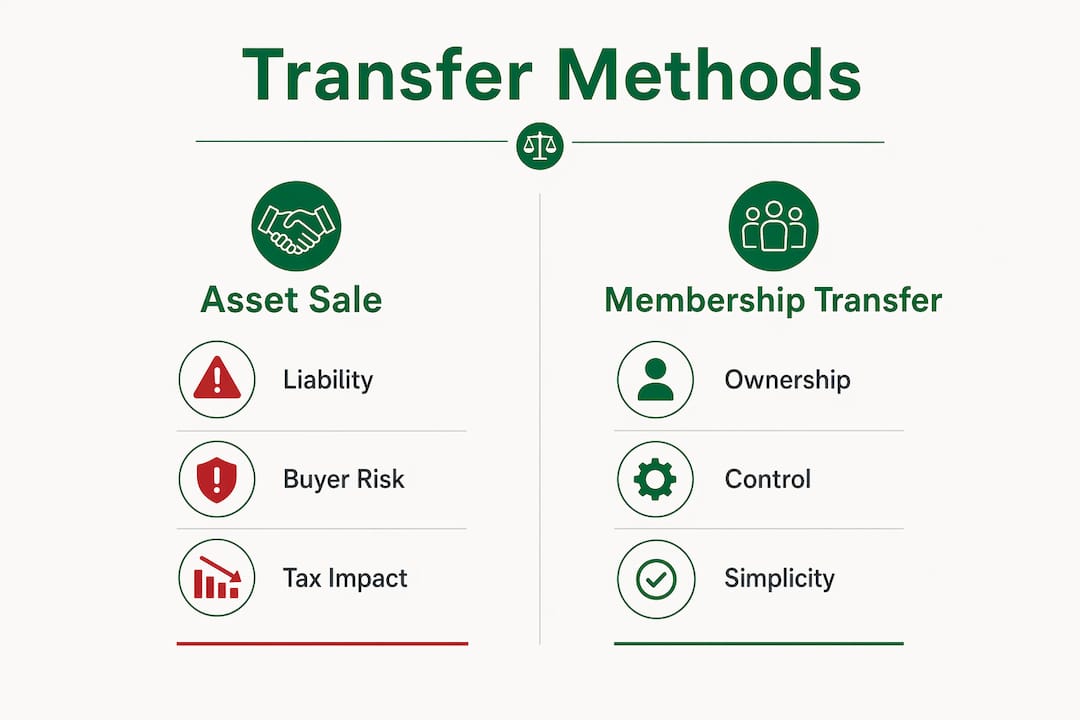
Asset sales allow sellers to mitigate liability by selling specified assets rather than the entire entity, but they require careful purchase price allocation to address Florida documentary stamp taxes. Misallocating the purchase price is one of the most common and costly mistakes Florida sellers make.
Transferring LLC membership interests is the most common structure for small business sales in Florida. Transferring economic interest can happen more freely than transferring governance rights, but buyers typically want both. That distinction matters because a buyer who only receives economic interest has no vote and no management authority.
Pro Tip: If your business carries significant liabilities or pending litigation, an asset sale protects the buyer and often makes the deal easier to close. If your business is clean and the buyer wants simplicity, a membership interest transfer is faster and cheaper to execute.
Step-by-step process to execute a florida business transfer
The business ownership transfer process in Florida follows a defined sequence. Skipping steps or reordering them creates legal exposure for both parties.
-
Prepare your business for sale. Clean up financials, resolve open disputes, and update all licenses and permits. Well-prepared businesses with clean financials close faster. The typical Florida business sale takes 6–12 months, with simpler deals under $500,000 often completing in 4–6 months.
-
Draft and negotiate a Letter of Intent (LOI). The LOI sets price, structure, and key terms before the formal purchase agreement. The LOI phase represents the seller’s peak negotiating leverage. Critical issues like consulting arrangements and earnouts must be detailed here. Waiting until the purchase agreement stage reduces your leverage significantly.
-
Conduct due diligence. The buyer reviews your financials, contracts, leases, employee agreements, and any pending litigation. You must disclose material facts about the business. Failure to disclose known issues creates post-closing liability.
-
Draft and execute the purchase agreement. This is the binding contract that governs the entire transaction. It covers price, representations and warranties, indemnification, and closing conditions. A Florida business attorney should draft or review this document before you sign.
-
Execute ownership transfer documents. For an LLC, this means a membership interest assignment agreement signed by all required parties. For an asset sale, you execute individual bills of sale for each asset category.
-
File amendments with the Florida Division of Corporations. Update the registered agent, members, and managers on record. Florida requires these filings to reflect the new ownership structure officially.
-
Notify the IRS and relevant agencies. Depending on the structure, you may need to apply for a new Employer Identification Number (EIN), notify the Florida Department of Revenue, and update business licenses at the county and municipal level.
Post-closing obligations matter as much as the closing itself. Common pitfalls to avoid include:
- Failing to transfer business licenses that are not automatically assignable
- Overlooking lease assignment requirements that need landlord consent
- Missing state or local permit transfer deadlines
- Neglecting to update bank accounts and financial accounts under the new ownership
What are the tax and financial considerations after transfer?
Tax planning is not a post-closing task. It belongs at the beginning of the process, not the end. The structure you choose directly determines your federal and state tax exposure.
Proper purchase price allocation during asset sales is critical to managing Florida documentary stamp tax exposure on tangible personal property. Allocating too much value to goodwill versus equipment can shift your tax burden in ways that are difficult to reverse after closing.
Key financial considerations for Florida business owners include:
- Federal capital gains tax: Long-term capital gains rates apply if you held the business for more than one year. The rate depends on your total income for the year.
- Florida documentary stamp tax: Florida imposes this tax on certain transfers of real property and some business assets. The rate is $0.70 per $100 of consideration in most Florida counties.
- Purchase price allocation: Both buyer and seller must file IRS Form 8594 for asset acquisitions above certain thresholds. Mismatched allocations trigger IRS scrutiny.
- Employee and contract transitions: Existing employment agreements, vendor contracts, and customer agreements may require novation or assignment. Some contracts include change-of-control clauses that allow termination upon ownership transfer.
Pro Tip: Work with a CPA and a Florida business attorney together during the LOI stage, not after. Tax structure decisions made before the purchase agreement is signed can save tens of thousands of dollars compared to restructuring after the deal is done.
Post-closing transition periods where the seller remains as a consultant for weeks to years are standard practice in Florida business sales. These arrangements protect client relationships, maintain employee morale, and preserve the value the buyer paid for. Build the consulting agreement terms into the LOI, not as an afterthought in the purchase agreement.
For a full legal and financial checklist before you start the process, the pre-sale planning guide from Fornarolegal covers the key steps Florida owners often miss.
Key takeaways
A successful Florida business ownership transfer requires legal preparation, the right transfer structure, and disciplined execution from LOI through post-closing transition.
| Point | Details |
|---|---|
| Start with your operating agreement | Review consent requirements and transfer restrictions before approaching any buyer. |
| Choose the right transfer structure | Asset sales, membership interest transfers, and mergers each carry different tax and liability outcomes. |
| Negotiate hard at the LOI stage | Seller leverage peaks at the LOI phase; finalize consulting and earnout terms before signing. |
| File with Florida Division of Corporations | Update ownership records officially after closing to protect both parties legally. |
| Plan post-closing transition early | Consulting agreements and transition periods protect deal value and client continuity. |
What i’ve learned after 20 years of florida business transfers
The single most common mistake I see Florida business owners make is treating the operating agreement as a formality. They signed it years ago, filed it away, and never looked at it again. Then a buyer appears, and suddenly that document controls everything: who must consent, whether the transfer is even permitted, and what rights the buyer actually receives.
I have seen deals collapse at the closing table because a minority member refused to consent and the operating agreement gave them that power. I have also seen sellers lose significant negotiating leverage because they waited until the purchase agreement stage to raise consulting arrangement terms. The LOI is where you protect yourself. Once that window closes, your options narrow fast.
The other pattern I see consistently is owners underestimating the timeline. A business sale in Florida rarely closes in under six months, and complex deals routinely run a full year. Owners who plan for business succession years in advance get better prices, cleaner closings, and fewer post-closing disputes. Owners who wait until they are burned out or facing a health issue take whatever the market offers.
My advice is direct: engage a Florida business attorney before you talk to a buyer, not after. The legal structure of your deal, the language in your LOI, and the consent provisions in your operating agreement will determine whether you walk away satisfied or spend the next two years in litigation.
— Matthew
Ready to transfer your florida business the right way?
Fornarolegal works with South Florida business owners through every stage of the ownership transfer process, from operating agreement review and LOI drafting to purchase agreement negotiation and post-closing filings. Matthew Fornaro brings over 20 years of court-tested experience to transactions that demand precision and speed.

Getting the legal structure right from the start is the most cost-effective decision you will make in this process. Disputes that arise from poorly drafted agreements or missed consent requirements cost far more to resolve than they cost to prevent. Learn how early legal guidance protects your transaction and your bottom line. Contact Fornarolegal before your first buyer conversation, not after.
FAQ
What documents are required to transfer business ownership in florida?
The core documents include a purchase or membership interest assignment agreement, member consent resolutions, a good standing certificate, and financial disclosures. For LLCs, you must also file amendments with the Florida Division of Corporations to update ownership records.
How long does a florida business ownership transfer take?
The typical timeline is 6–12 months, with simpler transactions under $500,000 often closing in 4–6 months. Well-prepared businesses with clean financials and updated operating agreements close faster.
Does florida require unanimous member consent to transfer an LLC?
Yes. Florida’s Revised LLC Act requires unanimous member consent to transfer full governance rights in an LLC. Operating agreements often add further restrictions, including rights of first refusal.
What is the difference between an asset sale and a membership interest transfer?
An asset sale transfers specific business assets while the seller retains existing liabilities. A membership interest transfer conveys full ownership of the LLC, including all liabilities, to the buyer.
When should i start planning a florida business ownership transfer?
Experts recommend starting 3–10 years in advance to maximize value, clean up financials, and resolve any legal issues. At minimum, begin the legal review process at least six months before approaching buyers.
Recommended
- Navigating the Complexities of Real Estate Transactions in Florida: A Legal Guide for Business Owners » Matthew Fornaro, P.A.
- What to Consider Before Selling or Winding Down a Florida Business: A Legal Checklist » Matthew Fornaro, P.A. Coral Springs Parkland Business Law
- A Comprehensive Legal Guide to Business Dissolution in Florida: Safeguarding Your Interests » Matthew Fornaro, P.A.
- Navigating Florida’s Unique Business Law Landscape: Essential Insights for Entrepreneurs » Matthew Fornaro, P.A.


