

Key Takeaways
- Florida business law protects companies from unfair competition, contract breaches, and partner disputes.
- Acting early saves time, money, and business relationships.
- An experienced business attorney helps you assess risk and choose the right legal strategy.
A litigation hold is a formal legal directive requiring an organization to suspend all routine deletion of documents, emails, and electronically stored information once litigation is reasonably anticipated. Also called a legal hold or preservation hold, this obligation arises before any lawsuit is filed. Failure to comply carries severe consequences, including adverse jury instructions, evidence exclusion, and spoliation sanctions. For South Florida business owners and legal professionals, understanding the litigation hold definition and its practical requirements is not optional. It is the foundation of defensible litigation readiness.
What is a litigation hold and when does it apply?
A litigation hold is triggered the moment an organization reasonably anticipates litigation, not when a complaint is formally served. This distinction is critical and frequently misunderstood. Courts have consistently held that waiting for a filed lawsuit before preserving evidence is too late.
The reasonable anticipation standard was firmly established in Zubulake v. UBS Warburg, a landmark series of rulings from the Southern District of New York that redefined preservation obligations in the digital age. Those decisions require counsel to actively monitor compliance, not simply issue a notice and assume custodians will act. Federal Rule of Civil Procedure Rule 37(e) codifies the consequences of failing to preserve electronically stored information, authorizing courts to impose sanctions when data is lost due to a failure to take reasonable steps.
Common triggering events include:
- A demand letter from an opposing party or their attorney
- An internal complaint alleging discrimination, harassment, or contract breach
- A government investigation or regulatory inquiry
- A formal notice of intent to sue
- Discovery of an internal incident likely to result in a claim
“The duty to preserve arises when litigation is reasonably anticipated, regardless of whether a lawsuit has been filed. Organizations that wait for service of process before acting face serious evidentiary and financial consequences.”
The importance of litigation holds cannot be overstated. Courts treat spoliation, the destruction or loss of relevant evidence, as a serious offense. Sanctions range from monetary penalties to adverse inference instructions, where a jury is told to assume the missing evidence would have harmed the party that failed to preserve it.
How to implement a litigation hold: the core process
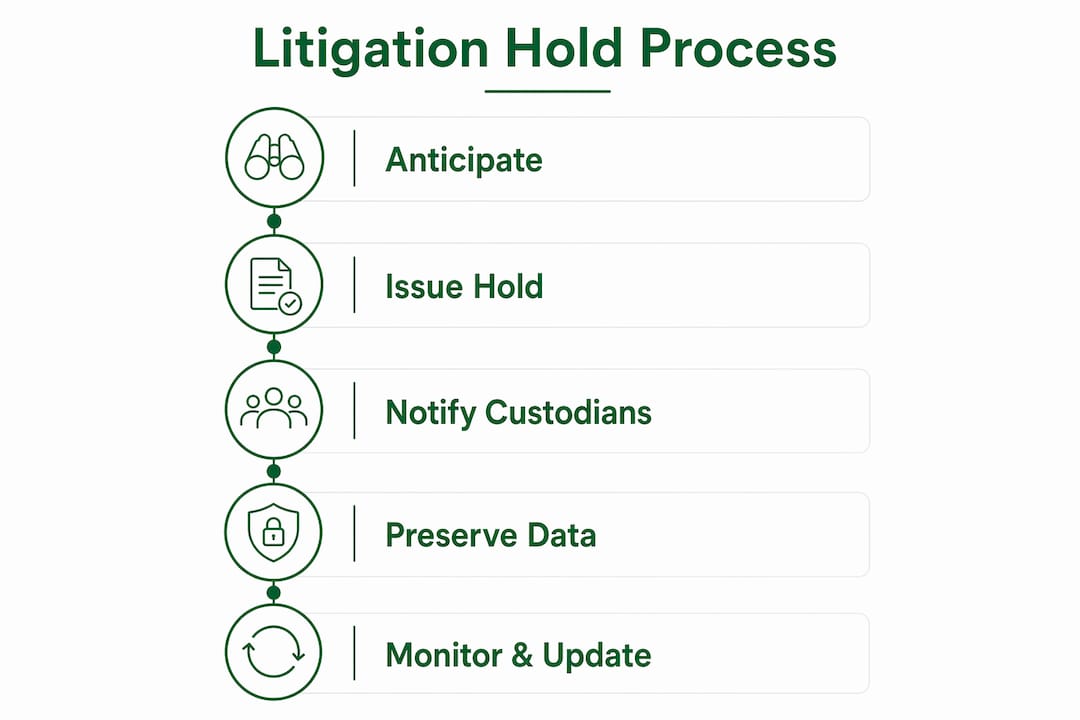
Implementing a litigation hold requires a structured, documented process. Issuing a single email to a few employees does not satisfy the legal standard. Effective litigation holds require written notices that define the matter, specify preservation obligations, identify the scope of relevant data, and require custodian acknowledgment.
The litigation hold process breaks down into six concrete steps:
- Identify the triggering event. Counsel or the legal team confirms that litigation is reasonably anticipated and documents the basis for that determination.
- Map relevant data sources. Identify all custodians, systems, and locations holding potentially relevant information. This includes email servers, cloud storage platforms like Microsoft 365 or Google Workspace, mobile devices, and third-party applications.
- Issue a written litigation hold notice. The notice must describe the legal matter, the categories of relevant documents, the preservation obligation, and the deadline for acknowledgment. A litigation hold notice template should be reviewed by counsel before use to confirm it meets current legal standards.
- Suspend auto-deletion policies. Work with IT to disable automatic purge features at the server or cloud level. Relying on custodians to manually preserve data is insufficient and creates gaps.
- Collect acknowledgments and monitor compliance. Every custodian must confirm receipt and understanding. Compliance monitoring must be ongoing, not a one-time check.
- Document everything. Maintain a detailed audit trail of when the hold was issued, who received it, and what steps were taken to preserve data.
Pro Tip: Never rely solely on email notices to custodians. Automated in-place preservation at the server or cloud level is best practice because it removes human error from the preservation equation entirely.
A common and costly mistake is treating the hold as a one-time task. Courts expect ongoing monitoring and reissuance of notices when new custodians are identified or when the scope of the matter expands. The litigation readiness audit process at Fornarolegal regularly uncovers organizations that issued an initial notice but never followed up, leaving them exposed to spoliation claims months later.

Litigation hold vs. legal hold: what’s the difference?
These two terms are often used interchangeably, but they describe distinct concepts with different scopes and purposes. Understanding the difference helps organizations calibrate their preservation efforts and avoid over-preserving or under-preserving data.
| Concept | Scope | Trigger | Duration |
|---|---|---|---|
| Litigation hold | Specific to anticipated or active litigation | Demand letter, lawsuit, or reasonable anticipation of suit | Until matter fully resolves, including appeals |
| Legal hold | Broader: covers investigations, audits, regulatory inquiries | Regulatory notice, internal investigation, compliance review | Until the underlying matter concludes |
| Records retention policy | Routine business operations | Scheduled intervals per company policy | Ongoing, per retention schedule |
Legal holds and litigation holds are related but distinct. A legal hold may be issued in response to an SEC inquiry or an internal HR investigation with no active lawsuit in sight. A litigation hold is narrower and more urgent, focused on preserving evidence for a specific legal dispute. Recognizing these differences allows organizations to tailor their information governance strategies rather than applying a blanket freeze to all data whenever any legal issue arises.
Differentiating between the two also matters for privilege. Hold communications tied to anticipated litigation are more clearly protected by attorney-client privilege than broader compliance-related notices, which may not carry the same protection.
Advanced challenges in managing litigation holds
Even well-designed holds face real-world complications. The most common failure points involve departing employees, privilege management, and the explosion of new data types.
Departing employees and silent holds. When a custodian leaves the organization during an active hold, standard notice procedures break down. The solution is a silent hold, where IT proactively secures the departing employee’s data before their access is terminated. The custodian is not notified, preventing both data destruction and tipping off potential adverse parties.
Privilege protection. Hold communications must be carefully managed to preserve attorney-client privilege. Hold notices should be marked confidential and privileged, distributed only to those who need to receive them. Overbroad distribution risks waiver, making the hold notice itself discoverable by opposing counsel.
New data types. Modern organizations generate evidence across platforms that did not exist a decade ago. AI chat logs, collaboration tools like Slack and Microsoft Teams, and ephemeral messaging applications all require specific preservation strategies. A hold that covers email but ignores Teams channels is incomplete and indefensible.
Pro Tip: Build a data map before litigation arises. Knowing where your organization stores information, across every platform and application, allows you to issue a complete and defensible hold within hours of a triggering event rather than scrambling for days.
Courts are raising the bar. 2026 rulings show courts increasingly expect parties to meet preservation duties proactively, without waiting for a court order. Organizations that demonstrate documented, automated preservation processes are rewarded with favorable treatment. Those that cannot show a coherent process face sanctions even when the data loss was unintentional.
Best practices when you receive or issue a hold notice
Whether you are on the receiving end of a hold or issuing one, the first 48 hours are the most consequential. Delayed action is the single most common mistake during business litigation that Fornarolegal sees in practice.
Follow these steps immediately:
- Notify legal counsel. Do not attempt to manage a litigation hold without attorney involvement. Counsel determines scope, drafts the notice, and protects privilege.
- Coordinate with IT. Legal and IT must work together to suspend auto-deletion policies and identify all relevant data repositories before any routine purge runs.
- Issue written notices promptly. Every identified custodian receives a written notice with a clear acknowledgment deadline. Track responses in a centralized system.
- Create a hold register. Document the matter name, triggering event, issue date, custodians, data sources covered, and all subsequent updates. This register is your defense against spoliation claims.
- Plan for the hold’s end. A litigation hold lasts until the matter fully resolves, including all appeals. Release requires a formal written notice and a technical lift of preservation settings. Releasing prematurely can result in evidence loss and sanctions.
Releasing a hold is as legally significant as issuing one. Both actions require documentation and deliberate coordination between legal and IT.
Key takeaways
A litigation hold is a mandatory preservation obligation that begins at reasonable anticipation of litigation and requires active management, documented compliance, and formal release when the matter concludes.
| Point | Details |
|---|---|
| Trigger point | The duty to preserve arises at reasonable anticipation, not when a lawsuit is filed. |
| Written notice required | Every hold must include a written notice defining scope, custodians, and acknowledgment requirements. |
| Auto-deletion must stop | Suspend auto-purge policies at the server level; custodian compliance alone is insufficient. |
| Departing employees | Use silent holds to secure data from custodians leaving the organization during active litigation. |
| Formal release needed | A hold ends only with a written release notice and technical lift of preservation settings. |
Why litigation holds deserve more strategic attention
Most businesses treat litigation holds as a reactive fire drill. A demand letter arrives, someone panics, and a flurry of emails goes out asking people to “save everything.” That approach fails in court and it fails operationally.
After more than 20 years handling business disputes in South Florida, I have seen the consequences of that reactive posture firsthand. A client once lost a significant contract dispute not because the facts were against them, but because key email threads had been auto-deleted weeks before the hold was issued. The opposing party moved for sanctions. The court gave an adverse inference instruction. The case settled for far more than it should have.
What I have found actually works is treating the litigation hold process as a standing business procedure, not an emergency response. Organizations that maintain a current data map, have a litigation hold notice template reviewed by counsel, and have a working relationship between legal and IT can issue a defensible hold within hours. That speed and documentation quality changes how courts perceive you as a litigant.
The rise of AI-generated content and collaboration platforms like Slack and Teams has made this even more pressing. Courts are not waiting for the legal profession to catch up. The proactive preservation standard is already here. Businesses that build hold readiness into their operations before a dispute arises protect themselves in ways that no amount of reactive scrambling can replicate. If you are a Florida business owner and you cannot answer the question “where does our company store potentially relevant information,” that is the gap to close first.
— Matthew
How Fornarolegal helps Florida businesses stay hold-ready

A litigation hold issued too late or managed poorly can turn a winnable case into a costly settlement. Fornarolegal works with South Florida businesses to build litigation readiness before disputes escalate, including hold procedures, custodian protocols, and IT coordination frameworks that hold up in court. Matthew Fornaro brings over 20 years of court-tested experience to help entrepreneurs and established companies respond to legal threats with speed and precision. If your business has received a demand letter or anticipates a dispute, the time to act is now. Learn how early legal guidance prevents the costly mistakes that define so many business litigation outcomes in Florida.
FAQ
What is a litigation hold in simple terms?
A litigation hold is a formal instruction to stop deleting documents and data once a lawsuit is anticipated or filed. It applies to emails, files, texts, and any other information relevant to the legal matter.
When does the duty to preserve evidence begin?
The duty to preserve begins when litigation is reasonably anticipated, which is often triggered by a demand letter or internal complaint, well before a lawsuit is formally filed.
What happens if a company ignores a litigation hold?
Courts can impose sanctions including monetary penalties, adverse inference jury instructions, or evidence exclusion. In serious cases, a judge may dismiss claims or enter default judgment against the non-compliant party.
How is a litigation hold different from a legal hold?
A litigation hold applies specifically to anticipated or active litigation, while a legal hold covers a broader range of legal obligations including regulatory investigations and internal audits. The scope, trigger, and duration differ between the two.
How long does a litigation hold last?
A litigation hold remains in effect until the legal matter is fully resolved, including all appeals and related proceedings. Releasing a hold requires a formal written notice and a technical lift of all preservation settings.
Recommended
- Understanding Commercial Litigation Law: A Guide for Florida Businesses » Matthew Fornaro, P.A.
- Litigation Readiness for Florida Businesses: A Proactive Guide Before Disputes Escalate » Matthew Fornaro, P.A.
- Commercial Litigation Attorneys: A Guide to Protecting Your Business » Matthew Fornaro, P.A.
- Navigating the Business Litigation Process in Florida: A Strategic Guide for 2026


