

Key Takeaways
- Florida business law protects companies from unfair competition, contract breaches, and partner disputes.
- Acting early saves time, money, and business relationships.
- An experienced business attorney helps you assess risk and choose the right legal strategy.
A post-acquisition dispute is a formal conflict between a buyer and seller that arises after a merger or acquisition closes, typically over financial adjustments, contract breaches, or earn-out disagreements. These conflicts are far more common than most executives expect. Nearly 10% of M&A transactions result in formal disputes, while 70–90% of acquisitions fail to deliver the value buyers anticipated. That gap between expectation and reality is where most post-acquisition issues are born. Understanding what triggers these conflicts, and how to manage them, is the clearest path to protecting the value you worked to create.
What is a post-acquisition dispute, and what causes one?
A post-acquisition dispute is any legal or contractual conflict that surfaces after a deal closes. The industry term used in M&A practice is “post-closing dispute,” and it covers a wide range of financial, operational, and legal disagreements between the parties to a transaction.
Common dispute types include breach of warranty claims, conflicts over earn-out provisions, and disagreements on working capital or purchase price adjustments. Each category carries its own legal complexity and timeline. Knowing which type you are facing shapes every decision that follows.

Financial causes
Financial disputes are the most frequent trigger. Purchase price adjustment disputes commonly stem from ambiguous working capital calculations and conflicting accounting applications. When the acquisition agreement fails to define which accounting standard governs the closing balance sheet, buyers and sellers often reach opposite conclusions using the same numbers.
Earn-out conflicts are equally contentious. Earn-out disputes often focus on whether performance targets were met and whether management actions after closing affected those results. A buyer who restructures the acquired business and then claims the seller missed revenue targets will face a credible counter-argument that the restructuring itself caused the shortfall.
Operational and legal causes
Operational failures create a second category of buyout conflict. Key talent turnover can reach 47% in acquired companies, and IT integration problems occur in 84% of deals. Both failures erode the synergies that justified the purchase price and frequently become the basis for warranty or misrepresentation claims.
Legal causes include:
- Breach of warranty claims: The seller represented facts about the business that later prove false or misleading.
- Misrepresentation: The seller made statements during due diligence that induced the buyer to close on unfavorable terms.
- Ambiguous contract language: Undefined terms in the acquisition agreement create room for competing interpretations.
- Missed notification deadlines: Short contractual windows for warranty claims cause buyers to lose rights when they miss strict notification deadlines, often set at 12–24 months post-close.
Rushed negotiations are a consistent driver across all categories. When deal teams prioritize speed over precision, the gaps in the agreement become the dispute.
How disputes after acquisition damage business value and leadership
Post-merger challenges do not stay contained to the legal department. They spread quickly into operations, culture, and executive credibility.
The most direct damage is financial. Every dollar spent on dispute resolution is a dollar not invested in integration. Legal fees, management distraction, and delayed synergy capture compound the original problem. A dispute over a $2 million working capital adjustment can cost far more than that figure in total business impact when you account for leadership time and operational disruption.
Cultural damage is harder to quantify but equally destructive. Post-acquisition disputes are entangled with cultural clashes and leadership misalignment, which makes resolution harder and integration slower. Employees on both sides watch how leadership handles conflict. A protracted, adversarial dispute signals instability and accelerates voluntary attrition.
“Post-acquisition disputes are as much about emotional and identity conflicts as financial differences. Balanced legal strategies protect not just the money at stake, but the reputation and future deal flow of everyone involved.”
Directors face personal exposure as well. Directors can be held personally liable for failing to exercise reasonable care and diligence during due diligence and integration phases. That liability is not theoretical. Governance standards in 2026 place heightened scrutiny on board-level oversight of M&A transactions, and regulators have shown willingness to pursue individual accountability.
Pro Tip: Document every material decision made during integration, including the rationale behind it. That paper trail is your first line of defense if a director liability claim surfaces later.
Zero-sum thinking is the psychological accelerant that turns manageable disagreements into full litigation. After closing, parties often shift from collaborative negotiation to adversarial financial adjustment. Every dollar one side gains feels like a direct loss to the other. Recognizing that dynamic early is the first step toward breaking it.
How to prevent and manage post-acquisition disputes effectively
Prevention starts before the deal closes. The single most effective tool is disciplined contract drafting with explicit accounting standards and risk allocation defined in writing.
-
Define every calculation method in the agreement. Specify which accounting standard governs the closing balance sheet, how EBITDA is calculated, and what items are included or excluded from working capital. Ambiguity here is the leading cause of purchase price adjustment conflicts.
-
Stress-test your deal assumptions before signing. Run the numbers under multiple accounting interpretations. If two reasonable accountants reach different conclusions using your draft language, rewrite the language before you close.
-
Bring in integrated legal, accounting, and tax advisory input simultaneously. These disciplines intersect in M&A agreements. A tax position can affect the purchase price calculation. An accounting method can determine whether an earn-out target is met. Siloed advice creates gaps.
-
Build a clear dispute resolution framework into the agreement. Specify whether disputes go to an independent accountant, a mediator, an arbitrator, or a court. Define the timeline and the governing rules. Parties who agree on process before a dispute arises resolve conflicts faster and at lower cost.
-
Set internal notification protocols before closing. Assign a team member to monitor warranty claim deadlines and document any potential issues from day one of integration. Missing a notification window forfeits rights that cannot be recovered.
-
Balance firm enforcement with relationship management. Not every dispute requires maximum legal aggression. Preserving the working relationship with former owners who hold institutional knowledge or customer relationships often produces better outcomes than winning every legal point.
Pro Tip: When drafting earn-out provisions, include explicit protections against post-close management decisions that could artificially suppress performance metrics. Courts look at this carefully, and so will your counterpart’s attorney.
| Prevention method | Primary benefit | Best applied |
|---|---|---|
| Explicit accounting definitions | Eliminates working capital disputes | During contract drafting |
| Stress-testing deal assumptions | Reveals ambiguous calculation gaps | Pre-signing review |
| Integrated advisory team | Catches cross-discipline risks | Throughout negotiation |
| Dispute resolution clause | Reduces cost and timeline of conflicts | At agreement execution |
| Notification deadline tracking | Preserves warranty claim rights | From day one post-close |
Managing contract disputes early is consistently less expensive than litigating them after they escalate. The cost difference is not marginal. It is often the difference between a negotiated resolution and a multi-year legal battle.
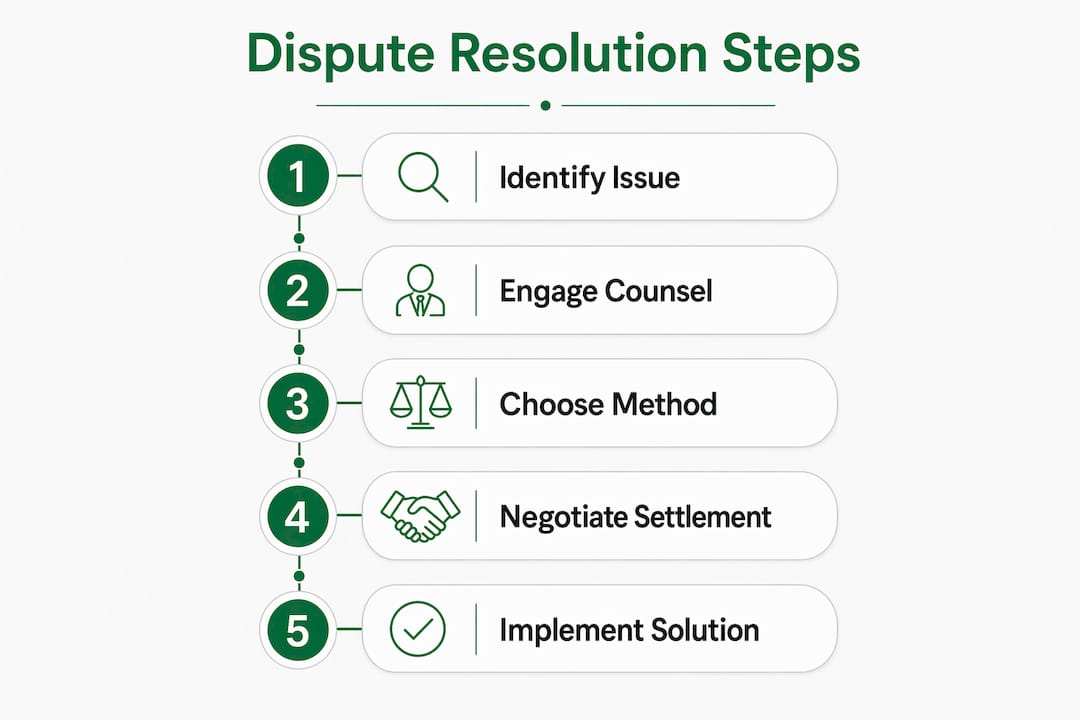
What are the main dispute resolution options for acquisition conflicts?
Settling acquisition disputes requires choosing the right process for the specific conflict. The four primary options each carry different cost, speed, and relationship implications.
- Negotiation: Direct settlement between the parties, with or without counsel. The fastest and least expensive option. Works best when both sides have a continuing business relationship and a shared interest in resolution.
- Mediation: A neutral third party facilitates settlement discussions but has no authority to impose a result. Mediation preserves confidentiality and keeps the parties in control of the outcome. It is particularly effective for disputes involving cultural or relationship dimensions.
- Arbitration: A neutral arbitrator or panel issues a binding decision. Arbitration is faster than litigation and keeps the dispute private. Many acquisition agreements specify arbitration for financial disputes and designate an independent accountant as the arbitrator for purchase price adjustments.
- Litigation: Court proceedings produce a public, enforceable judgment. Litigation is the most expensive and time-consuming option, but it is sometimes necessary when the other side refuses to negotiate in good faith or when the dispute involves fraud allegations.
Choosing between mediation, arbitration, or litigation depends on the size of the claim, the relationship between the parties, the governing contract language, and the strength of your evidence. A specialized attorney can map those factors quickly and recommend the right path.
Directors navigating post-acquisition conflict also face fiduciary duty obligations. Reasonable care, skill, and diligence are the standard. Failing to act on known disputes or ignoring integration risks can expose board members to personal claims separate from the company’s liability. In 2026, digital data protection failures during integration have become a new category of director liability, particularly where acquired companies held sensitive customer data.
Early resolution techniques consistently outperform reactive litigation on both cost and outcome. The executives who fare best in post-acquisition disputes are those who engage legal counsel before the dispute becomes a formal claim.
Key Takeaways
Post-acquisition disputes are predictable, preventable, and best managed with legal counsel engaged before a conflict becomes a formal claim.
| Point | Details |
|---|---|
| Disputes are common | Nearly 10% of M&A transactions result in formal post-closing disputes. |
| Financial triggers dominate | Working capital, earn-outs, and purchase price adjustments cause most conflicts. |
| Directors face personal liability | Failure to exercise reasonable care during integration can result in personal legal exposure. |
| Prevention beats litigation | Explicit contract definitions and stress-tested assumptions prevent most disputes before they start. |
| Process choice matters | Selecting the right resolution method, negotiation, mediation, arbitration, or litigation, determines cost and outcome. |
What I’ve learned after 20 years of post-acquisition conflict
The executives who call me after a deal closes in conflict almost always say the same thing: “We thought the hard part was getting the deal done.” The hard part is what comes after.
What I’ve seen consistently is that the disputes that escalate to litigation were rarely inevitable. They were the product of contract language that nobody stress-tested, notification deadlines that nobody tracked, and cultural friction that nobody addressed until it became adversarial. The financial disagreement is usually the symptom. The real problem is that the parties stopped communicating the moment the ink dried.
The balance between aggression and diplomacy is real and it matters. Pursuing every legal right at maximum force can win a financial argument and destroy a business relationship that still has value. Former owners who stay engaged post-close often hold customer relationships, vendor contacts, and institutional knowledge that the buyer cannot replace. Burning that bridge to win a working capital dispute is a bad trade.
What I tell clients is this: know your rights, document everything, and engage counsel before you send the first formal notice. The 48-hour window after a dispute surfaces is when the most important decisions get made, usually without enough information. Slow down, get legal input, and treat the dispute as a problem to solve rather than a battle to win. That mindset produces better outcomes than any litigation strategy I’ve seen.
— Matthew
Fornarolegal’s approach to post-acquisition conflict
Post-acquisition disputes move fast, and the decisions made in the first weeks after a conflict surfaces shape everything that follows.

Fornarolegal has represented business owners and executives across South Florida in M&A disputes for over 20 years, with AV-rated, court-tested experience in contract enforcement, warranty claims, and earn-out conflicts. The firm’s approach focuses on early legal guidance to contain disputes before they escalate to full litigation. Whether you are facing a purchase price adjustment conflict, a breach of warranty claim, or a breakdown in post-close negotiations, Fornarolegal provides direct, practical counsel built for the pace of business. Contact the firm to discuss your situation and understand your options before the next deadline passes.
FAQ
What is a post-acquisition dispute?
A post-acquisition dispute is a legal or contractual conflict between a buyer and seller that arises after a merger or acquisition closes. Common triggers include working capital adjustments, earn-out disagreements, and breach of warranty claims.
How long do buyers have to raise warranty claims?
Notification deadlines for warranty claims are typically set at 12–24 months post-close in the acquisition agreement. Missing that window forfeits the buyer’s right to indemnification, regardless of the merit of the claim.
What is the most common type of post-merger dispute?
Purchase price adjustment and working capital disputes are the most frequent post-merger challenges. They arise when the acquisition agreement fails to define the accounting methods used to calculate the closing balance sheet.
Can directors be personally liable in post-acquisition disputes?
Directors can face personal liability for failing to exercise reasonable care and diligence during due diligence and integration. Governance standards in 2026 place heightened scrutiny on board-level oversight of M&A transactions.
Is arbitration better than litigation for settling acquisition disputes?
Arbitration is faster, less expensive, and keeps the dispute private, making it the preferred choice for most financial post-acquisition conflicts. Litigation is appropriate when the other party refuses to negotiate or when fraud allegations require a public, enforceable judgment.


