

Key Takeaways
- Florida business law protects companies from unfair competition, contract breaches, and partner disputes.
- Acting early saves time, money, and business relationships.
- An experienced business attorney helps you assess risk and choose the right legal strategy.
Table of Contents
- Common Types of Commercial Lease Disputes and Their Financial Impact
- The Commercial Lease Dispute Resolution Clause: What It Must Include
- Commercial Lease Dispute Resolution Strategies: Tenant vs. Landlord Perspectives
- The Commercial Lease Mediation Process: A Step-by-Step Breakdown
- Commercial Lease Arbitration vs. Litigation: Choosing the Right Path
- Digital Evidence Management and Dispute Avoidance Tactics
- Using a Commercial Lease Dispute Settlement Agreement Template Effectively
- Proven Commercial Lease Dispute Resolution Strategies for South Florida Businesses
- Conclusion
Last Updated: May 29, 2026
Resolving a commercial lease conflict without a clear plan is one of the most expensive mistakes a business owner can make. Commercial lease dispute resolution strategies determine whether a conflict costs you weeks of productivity or years of litigation. At Matthew Fornaro, P.A., we have helped South Florida entrepreneurs and small business owners protect their interests through every stage of a lease lifecycle, from initial review through post-resolution implementation. Below, we’ll show you exactly how to approach these disputes tactically, whether you’re a tenant facing unexpected CAM charges or a landlord dealing with a defaulting occupant.
Most guides on this topic focus on legal definitions. This one focuses on outcomes.
Common Types of Commercial Lease Disputes and Their Financial Impact
Commercial lease disputes are disagreements between landlords and tenants over the terms, performance, or termination of a binding agreement governing commercial space. Understanding which disputes arise most frequently is the first step toward preventing them.
The financial impact of unresolved lease conflicts extends well beyond legal fees. Operational risk, disrupted cash flow, and damaged business relationships compound quickly once a dispute escalates. Many businesses find that the indirect costs, including lost productivity, management time, and reputational damage with neighboring tenants or property managers, outweigh the direct legal expenses.
CAM Charges and Operating Expense Disagreements
CAM (common area maintenance) charges are among the most contested items in any commercial lease. Tenants often discover, mid-lease or at reconciliation time, that operating expenses have been interpreted far more broadly than the original contract language suggested.
Common friction points include:
- Management fees calculated as a percentage of gross revenue rather than actual costs
- Capital improvements billed as operating expenses
- Expenses from properties outside the subject building included in the CAM pool
- Audit rights buried in the lease that tenants never exercise
The practical defense here is straightforward: negotiate a CAM cap at lease signing, require annual reconciliation statements with supporting documentation, and exercise your audit rights if numbers feel off. A lease without a defined audit right is a lease that invites overcharging.
Failing to exercise a CAM audit right within the window specified in your lease (often 12 months after receiving the reconciliation statement) can permanently waive your right to contest those charges. Read your lease’s audit clause carefully before the deadline passes.
Maintenance, Repair Obligations, and Default Claims
Maintenance and repair disputes frequently escalate into default claims because the contractual obligations are poorly defined at signing. Triple-net lease structures, common in South Florida commercial real estate, place most repair responsibilities on the tenant, including roof, HVAC, and structural systems in some cases.
A default claim based on alleged failure to maintain property can trigger eviction proceedings even when the underlying repair issue is minor. Tenants should document every maintenance request in writing, retain contractor invoices, and keep a timestamped log of landlord communications. Landlords, conversely, should issue formal written notices before escalating to legal remedies, creating a documented record that supports their position in any subsequent proceeding.
The Commercial Lease Dispute Resolution Clause: What It Must Include
The commercial lease dispute resolution clause is the contractual provision that governs how conflicts between landlord and tenant will be handled before, during, and instead of litigation. A well-drafted clause is the single most valuable tool for controlling the cost and duration of any future dispute.
A clause that simply states "disputes shall be resolved by arbitration" is insufficient. According to American Arbitration Association guidelines on commercial dispute clauses, effective dispute resolution provisions should specify the governing rules, seat of arbitration, number of arbitrators, and allocation of fees.
At minimum, a commercial lease dispute resolution clause should include:
- The ADR method – mediation, arbitration, or a tiered approach requiring mediation before arbitration
- The governing body – which organization administers the process (AAA, JAMS, or another named provider)
- The location – where proceedings will occur, critical for South Florida businesses with out-of-state landlords
- Fee allocation – who pays for the neutral mediator or arbitrator
- Carve-outs – which disputes (such as eviction or injunctive relief) can proceed directly to court
- Confidentiality provisions – whether the process and outcome remain private
State-specific rules matter here. Florida has its own arbitration statutes under the Florida Arbitration Code, and any clause that conflicts with those rules creates enforcement risk. Have legal counsel review the clause before signing.
Negotiate a tiered clause: require mediation first (30-day process, low cost), then binding arbitration only if mediation fails. This structure resolves most disputes in weeks rather than years, and both parties retain more control over the outcome than they would in litigation.
Commercial Lease Dispute Resolution Strategies: Tenant vs. Landlord Perspectives
The most effective commercial lease dispute resolution strategies look different depending on which side of the lease you occupy. Tenants and landlords have asymmetric leverage, asymmetric risks, and asymmetric goals, and a strategy that works well for one party can actively harm the other. Most guides on this topic offer generic advice that applies to neither side specifically. This section provides a distinct tactical playbook for each.
The Tenant Playbook: Protecting Your Business When a Dispute Arises
Tenants in commercial lease disputes operate from a structurally weaker position in one critical respect: the landlord controls the physical space your business depends on. That asymmetry shapes every tactical decision you make. The goal is not to win an argument, it is to protect your ability to operate while the dispute resolves.
Phase 1: The First 48 Hours After a Dispute Surfaces
The actions you take in the first two days after a conflict emerges have an outsized effect on how the dispute develops. Most tenants lose ground here by either doing nothing or escalating prematurely.
- Do not call. Write. Send an email to your landlord or property manager that describes the specific issue, references the relevant lease provision by section number, and states what resolution you are seeking. Keep the tone professional and factual. This email creates a timestamped record that establishes when you raised the issue and how you framed it, evidence that matters if the dispute escalates.
- Pull your lease and read the relevant section in full. Before you assert a position, confirm that the lease actually supports it. Many tenant disputes are weakened by misremembering what the lease says. Read the provision, the definitions section, and any related amendments.
- Identify your cure period. If you have received a default or cure notice, your lease specifies how many days you have to respond or remedy the alleged default. Missing that window can convert a manageable dispute into an eviction proceeding. In Florida, commercial lease cure periods are typically defined by contract rather than statute, so the lease controls.
- Photograph and document the physical condition of the premises immediately if the dispute involves maintenance, repairs, or property condition. Conditions change. Your documentation of the current state is only useful if it is created before the landlord makes any changes.
Phase 2: Negotiating from the Tenant’s Position
Tenants often underestimate their negotiating leverage. Landlords have strong incentives to keep a paying, operating tenant in place: vacancy is expensive, re-leasing takes time, and a tenant who leaves mid-dispute may leave in poor condition. Use that leverage deliberately.
- Lead with your payment history. A tenant with a clean rent payment record has significantly more credibility in a dispute than one with a history of late payments. If your record is strong, reference it explicitly in your communications.
- Propose a specific resolution, not just a complaint. Landlords respond better to tenants who come with a concrete proposal, a payment plan, a repair timeline, a lease modification, than to those who simply express dissatisfaction. Being the party with a solution gives you control of the framing.
- Invoke the dispute resolution clause proactively. If your lease requires mediation before litigation, request it formally and in writing before the landlord files anything. This positions you as the party acting in good faith and may slow any escalation while the process runs.
- Understand your assignment and subletting rights before you need them. If the business relationship is genuinely unsalvageable, knowing your exit options, subletting, assignment, early termination provisions, prevents a costly standoff. Review these provisions now, not after a default notice arrives.
Phase 3: Knowing When to Stop Negotiating
Negotiation has a point of diminishing returns. Stop negotiating and engage legal counsel immediately if:
- You receive a formal eviction notice or unlawful detainer filing
- The landlord has changed locks, restricted access, or interfered with utilities (constructive eviction)
- You are being asked to sign any document, including a ‘workout agreement’, without attorney review
- The dispute involves allegations of fraud, misrepresentation, or bad faith conduct
In Florida, a commercial landlord who changes locks or removes a tenant’s property without a court order may be liable for wrongful eviction damages. If this happens, document it immediately with photographs and timestamps and contact an attorney the same day. Do not attempt to re-enter the premises without legal guidance.
The Landlord Playbook: Protecting Your Asset and Your Cash Flow
Landlords face a different strategic reality. Eviction is slow and expensive in Florida, a vacant commercial space generates no revenue during the process, and a tenant who feels cornered may cause property damage, stop maintaining the space, or file counterclaims that complicate and delay recovery. The landlord’s strategic goal in most disputes is to get the tenant performing again, or to exit the relationship cleanly, not to win a legal argument.
Phase 1: The Cure Notice as a Strategic Tool, Not Just a Legal Requirement
Most landlords treat the cure notice as a formality before escalating to eviction. Experienced landlords treat it as a negotiating instrument.
A well-drafted cure notice does three things simultaneously: it creates the legal record required to support a subsequent eviction action, it gives the tenant a defined window to remedy the default (which most tenants will use if they can), and it opens a channel for negotiation without the landlord having to make the first concession. Issue the notice promptly, delay weakens your legal position, but use the cure period actively to assess whether a negotiated resolution is available.
Phase 2: Landlord Negotiating Tactics
- Separate the financial default from the relationship. A tenant who is three months behind on rent due to a temporary business disruption is a different situation from a tenant who is systematically underpaying CAM charges or damaging the property. The resolution strategy should match the actual problem.
- Offer a structured cure agreement for financial defaults. A written agreement that allows the tenant to repay arrears over a defined period, with clear default consequences if they miss a payment, often recovers more money faster than eviction. It also avoids the legal fees, court time, and vacancy period that eviction requires.
- Document every communication and every condition. Landlords who win disputes are almost always the ones with better records. Maintain a contemporaneous log of all tenant communications, maintenance requests, property inspections, and payment history. If the dispute reaches arbitration or litigation, this documentation is your foundation.
- Use the lease’s self-help remedies carefully. Some Florida commercial leases include self-help provisions allowing landlords to re-enter and re-let the premises after a defined default period. These provisions are enforceable in some circumstances but carry significant legal risk if exercised incorrectly. Consult counsel before acting on any self-help clause.
Phase 3: When Eviction Is the Right Answer
Eviction is the right strategic choice when the tenant is not paying and shows no credible path to curing the default, when the tenant is causing material damage to the property, or when the tenant’s continued occupancy is preventing a more valuable re-leasing opportunity. In those cases, move quickly and correctly: issue proper statutory notices, comply with the lease’s dispute resolution clause if it applies to eviction proceedings, and retain experienced commercial litigation counsel before filing.
The single most common landlord mistake in commercial lease disputes is skipping the ADR step required by the lease before filing for eviction. Florida courts have dismissed eviction actions on this basis. Read your lease’s dispute resolution clause before you file anything.
Where Tenant and Landlord Interests Actually Align
Despite the adversarial framing of most lease disputes, both parties share one fundamental interest: resolving the conflict quickly and cheaply so they can return to a functional business relationship, or exit it cleanly. The disputes that become expensive are almost always the ones where one or both parties lost sight of that shared interest early in the process. The playbooks above are designed to keep that interest in view, even when the conflict feels personal.
The Commercial Lease Mediation Process: A Step-by-Step Breakdown
Commercial lease mediation is a non-binding process in which a neutral mediator facilitates negotiation between disputing parties to help them reach a voluntary settlement. Unlike arbitration or litigation, neither party is bound by the mediator’s suggestions unless they sign a settlement agreement.
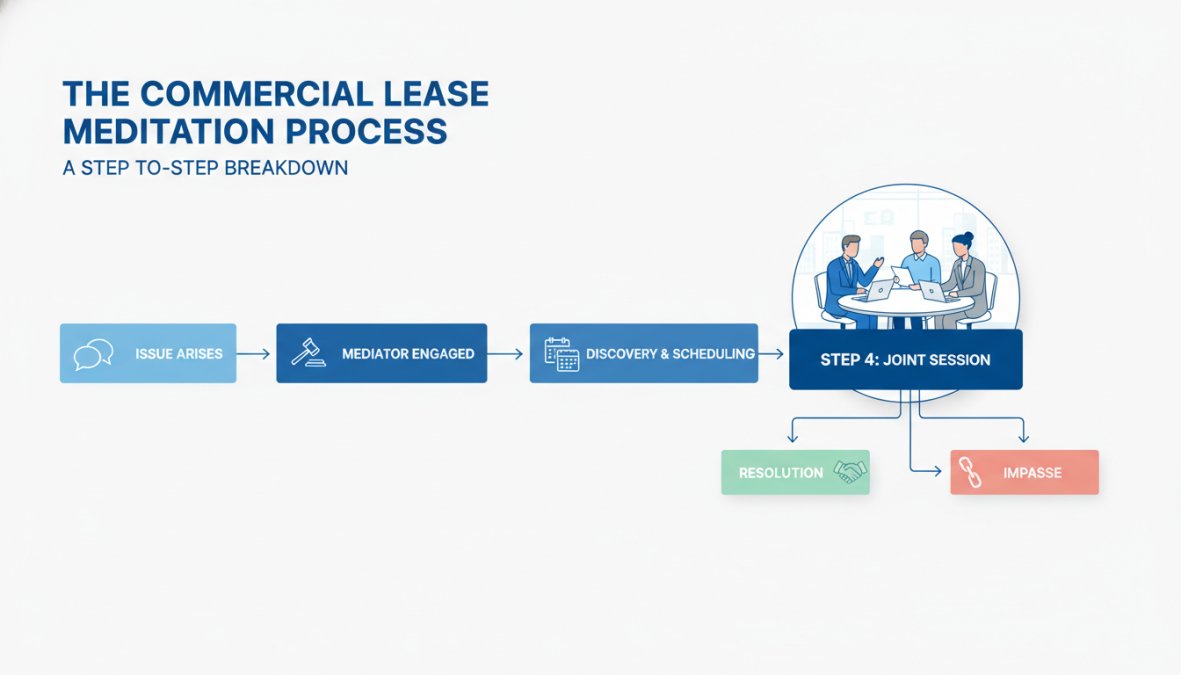
Here is how the process typically unfolds:
- Select a neutral mediator. Both parties agree on a mediator with commercial real estate experience. The American Bar Association and JAMS maintain rosters of qualified neutrals.
- Exchange position statements. Each party submits a brief written summary of their position and the relief they seek, usually 5-10 days before the session.
- Opening joint session. The mediator explains the process, establishes ground rules, and each party presents their perspective without interruption.
- Separate caucuses. The mediator meets privately with each side to explore interests, test proposals, and identify areas of potential agreement. This is where most movement happens.
- Joint negotiation. If caucuses produce viable proposals, the mediator brings parties back together to finalize terms.
- Settlement agreement. If the parties reach agreement, they sign a binding settlement agreement on the spot. If not, the mediation concludes and other options remain available.
The commercial lease mediation process typically takes one day and costs a fraction of litigation. Many South Florida commercial leases now require mediation as a precondition to any other legal remedy.
Commercial Lease Arbitration vs. Litigation: Choosing the Right Path
The choice between commercial lease arbitration and litigation is not simply a procedural question. It is a strategic business decision with direct consequences for cost, speed, privacy, and outcome predictability. Most guides stop at explaining what each option is. This section goes further: it gives you a practical cost-benefit framework for calculating which path actually makes financial sense for your specific dispute.
| Factor | Mediation | Arbitration | Litigation |
|---|---|---|---|
| Average duration | 1-2 days | 3-9 months | 1-3 years |
| Privacy | Confidential | Confidential | Public record |
| Relative cost | Lowest | Moderate | Highest |
| Outcome | Voluntary settlement | Binding, limited appeal | Appealable |
| Party control | High | Medium | Low |
| Discovery available | No | Limited | Full |
| Precedent value | None | None | Creates public precedent |
The Financial Decision Framework: Calculating Your Resolution ROI
Before choosing a path, run a simple financial triage on your dispute. Most business owners skip this step and default to whatever their attorney recommends without understanding the underlying economics. Here is a structured way to think through it.
Step 1: Quantify the amount actually in dispute.
Separate the core financial claim (unpaid rent, disputed CAM charges, repair costs) from the peripheral claims. Many disputes that feel large are actually concentrated in a narrow dollar range once you strip out the emotional components. A CAM reconciliation dispute that feels like a major conflict may involve a net exposure of a few thousand dollars once both sides’ positions are mapped.
Step 2: Estimate the fully-loaded cost of each path.
Litigation in Florida commercial courts routinely involves attorney fees, court filing costs, deposition expenses, and expert witness fees. A contested commercial lease case that proceeds through trial can consume a significant portion of the disputed amount in legal fees alone, sometimes exceeding the value of the original claim. Arbitration through a provider like AAA or JAMS carries its own administrative fees and arbitrator compensation, but these are typically a fraction of full litigation costs. Mediation is almost always the least expensive option, with a single-day session often resolving disputes for a fraction of what either formal process would cost.
Step 3: Assign a probability-weighted outcome.
This is the step most business owners skip entirely. Ask your attorney: what is a realistic range of outcomes if this goes to arbitration or trial? A claim with a strong factual record and clear contract language has a different expected value than one involving ambiguous lease terms or disputed facts. A 70% chance of recovering a given amount is worth less than that amount in expected value terms, and the cost of the process must be subtracted from whatever you might recover.
Step 4: Factor in the indirect business costs.
Litigation imposes costs that never appear on a legal invoice: management time diverted from operations, stress on the landlord-tenant relationship (which may have years remaining on the lease), potential reputational exposure from a public court filing, and the operational disruption of depositions and document production. For a small business owner, the opportunity cost of time spent on litigation can exceed the direct legal fees. These indirect costs almost always favor early resolution.
Step 5: Apply the breakeven test.
If the fully-loaded cost of litigation (attorney fees + indirect costs + probability-adjusted loss risk) exceeds the amount you would accept in a negotiated settlement, litigation is destroying value rather than creating it. This is the breakeven point at which settling, even at a number below your ideal outcome, is the rational business decision.
A practical rule of thumb used by experienced commercial litigators: if the disputed amount is less than the estimated cost of taking the matter through arbitration or trial, mediation is almost always the correct first step. Reserve formal proceedings for disputes where the stakes justify the process.
When Arbitration Makes Strategic Sense
Arbitration is the right choice when both parties want a final, binding resolution without the time and expense of full litigation. It works especially well for disputes involving technical lease interpretation questions, CAM reconciliation disagreements, or repair obligation conflicts where an experienced arbitrator with commercial real estate background can evaluate the facts efficiently.
The confidentiality of arbitration also matters for businesses operating in competitive markets. A public court filing detailing lease terms, rent amounts, and financial difficulties can damage a business’s reputation with suppliers, lenders, and customers. Keeping the dispute private through arbitration protects that information in a way litigation cannot.
Arbitration is also strategically preferable when the other party has significantly greater litigation resources. A small business tenant facing a large institutional landlord with in-house legal counsel is at a structural disadvantage in prolonged litigation. Arbitration compresses the timeline and limits the discovery process, which reduces the resource asymmetry.
When Real Estate Litigation Is the Better Option
Real estate litigation makes sense in a narrower set of circumstances than most people assume. The clearest cases are:
- Injunctive relief is needed immediately. If a landlord has wrongfully locked out a tenant or is interfering with business operations, a court can issue a temporary injunction on an emergency basis. Arbitration cannot move that fast.
- The dispute involves fraud or bad faith conduct. These claims often require full discovery, depositions, document production, interrogatories, to develop the factual record. Arbitration’s limited discovery process is a disadvantage here.
- The amount in dispute clearly justifies the cost. When the financial exposure is substantial and the factual record strongly supports your position, the higher cost of litigation may be worth the more complete process and the right to appeal an adverse decision.
- You need public precedent. If a landlord is engaged in the same disputed practice across multiple properties, a public court judgment creates a record that benefits other affected tenants and may deter future conduct.
According to Florida Courts overview of commercial litigation procedures, parties in commercial disputes retain the right to jury trial unless contractually waived, which can be a significant strategic advantage in certain fact patterns, particularly those involving landlord conduct that a jury is likely to view unfavorably.
The One Question That Drives the Decision
After running the financial framework above, most disputes reduce to a single question: do you need a process, or do you need an outcome? Litigation and arbitration are processes. A negotiated settlement or mediated agreement is an outcome. For most commercial lease disputes, especially those involving ongoing lease relationships, getting to an outcome faster and cheaper is worth more than winning a process. Choose based on what your specific dispute actually needs, not on what feels most satisfying in the moment.
Digital Evidence Management and Dispute Avoidance Tactics
Most commercial lease disputes are won or lost on documentation, not legal arguments. The party with better records almost always has better use.
Effective digital evidence management starts at lease signing, not when a dispute arises. Build these habits from day one:
- Create a dedicated lease folder with the executed lease, all amendments, LOIs, and correspondence organized by date
- Use email for all material communications with your landlord or tenant. Avoid resolving significant issues by phone without following up in writing
- Photograph the premises at move-in, annually, and at move-out with timestamped images stored in a cloud platform
- Retain all invoices and work orders related to maintenance and repairs, including contractor quotes you did not accept
- Log every maintenance request with the date submitted, method of submission, and landlord’s response time
- Archive CAM reconciliation statements and compare them year-over-year for unusual expense increases

Dispute avoidance is ultimately cheaper than dispute resolution. Many conflicts in South Florida commercial real estate stem from ambiguous contract language that both parties interpreted differently at signing. A pre-lease legal review by an experienced attorney catches most of these issues before they become expensive problems.
The single most effective dispute avoidance tactic is a thorough lease review before signing. Fixing ambiguous language costs a few hundred dollars in attorney time. Litigating over that same language costs tens of thousands.
Using a Commercial Lease Dispute Settlement Agreement Template Effectively
A commercial lease dispute settlement agreement template is a structured document that formalizes the terms both parties have agreed to at the conclusion of mediation or negotiation. Using a template effectively means understanding what it must contain to be enforceable, not just filling in blanks.
A complete settlement agreement should address:
- Full identification of parties – legal names of both landlord entity and tenant entity, not just trade names
- Description of the dispute – a brief factual summary of what was in conflict
- Specific resolution terms – exact dollar amounts, payment schedules, repair timelines, or lease modifications agreed upon
- Mutual release language – each party releases the other from claims arising from the described dispute
- Confidentiality clause – if the parties want the settlement terms to remain private
- Default consequences – what happens if either party fails to perform the settlement terms
- Governing law – Florida law, and the specific county for any enforcement action
The thing nobody tells you about settlement agreement templates is that the mutual release clause is the most negotiated and most dangerous provision. A release that is too broad can inadvertently waive rights unrelated to the current dispute. A release that is too narrow may not fully resolve the conflict. Always have legal counsel review the release language before signing.
As documented in Florida Bar guidance on settlement agreements and enforceability, settlement agreements in Florida are treated as contracts, meaning they are enforceable through a breach of contract action if either party fails to perform.
Proven Commercial Lease Dispute Resolution Strategies for South Florida Businesses
South Florida’s commercial real estate market operates under specific conditions that shape how lease disputes arise and how they resolve. Coral Springs, Parkland, and the broader Broward County market feature a mix of retail, office, and industrial tenants, many of them small businesses with limited legal resources and significant exposure to aggressive lease terms.
The commercial lease dispute resolution strategies that work best in this market share a common thread: they prioritize early intervention, documented communication, and professional legal guidance before a dispute reaches the formal stage.
When to Hire a Commercial Lease Attorney in Broward County
Hire a commercial lease attorney before you sign, not after a dispute arises. This is the most consistent piece of advice from practitioners who handle these matters regularly, and it is the advice most often ignored.
That said, if a dispute has already begun, these are the signals that professional legal counsel is no longer optional:
- You have received a formal default notice or cure notice
- Your landlord has threatened eviction or lease termination
- The dispute involves more than a few months of rent or CAM charges
- The other party has retained an attorney
- You are being asked to sign any document related to the dispute
Matthew Fornaro, P.A. has served Coral Springs, Parkland, and Broward County businesses for over two decades, handling commercial litigation, contract disputes, and lease conflicts for entrepreneurs and small business owners who need practical, results-oriented guidance. The firm’s deep familiarity with South Florida’s commercial real estate legal landscape means clients get advice grounded in local court practices and state-specific rules, not generic legal templates.
Post-Resolution Implementation: Protecting Your Business Going Forward
Reaching a settlement is not the end of the process. Post-resolution implementation is where many businesses lose the gains they negotiated.
After any lease dispute resolves, take these steps:
- Obtain a signed copy of the settlement agreement and store it with your lease documents immediately.
- Update your lease summary document to reflect any modifications to rent, CAM obligations, or repair responsibilities.
- Set calendar reminders for all performance deadlines in the settlement, including payment dates and repair completion milestones.
- Conduct a lease audit to identify other provisions that may create future disputes, now that you understand how your landlord or tenant interprets ambiguous language.
- Establish a communication protocol with the other party going forward, particularly if the lease continues for several more years.
- Review your dispute resolution clause in light of the experience you just had. If the clause was inadequate, negotiate an amendment.
The businesses that avoid repeat disputes are the ones that treat the resolution as a learning event, not just a problem solved. A conflict that reveals a gap in your lease documentation is an opportunity to close that gap before it costs you again.
Commercial lease conflicts are a predictable part of running a business in South Florida, but they do not have to be expensive or protracted. The right combination of proactive lease review, clear documentation habits, and early legal intervention resolves most disputes before they reach formal proceedings. Matthew Fornaro, P.A. brings over two decades of experience and deep local knowledge of Broward County’s commercial legal landscape to help Coral Springs and South Florida business owners resolve disputes efficiently and protect their interests for the long term. Call today to speak with an attorney who understands both the legal strategy and the business stakes.
Frequently Asked Questions
What are the most common causes of commercial lease disputes?
The most common causes include disagreements over CAM charges and operating expenses, unclear maintenance and repair obligations, breach of contract claims, exclusivity clause violations, rent relief requests, and disputes over lease termination or renewal terms. In triple-net lease arrangements, operating expense audits frequently trigger conflicts. Reviewing contract language carefully before signing and maintaining thorough documentation throughout the lease lifecycle can significantly reduce the risk of these disputes arising.
What should be included in a commercial lease dispute resolution clause?
A strong commercial lease dispute resolution clause should specify the preferred ADR method, mediation, arbitration, or both in sequence, along with timelines for initiating each process, how a neutral mediator or arbitrator is selected, whether the process is binding or non-binding, the governing state-specific rules, cost allocation between parties, and the location for proceedings. Including these details upfront prevents ambiguity and reduces litigation risk if a conflict arises during the lease term.
Is mediation effective for commercial lease disputes?
Mediation is often highly effective for commercial lease disputes because it is a non-binding process that allows both parties to negotiate a settlement with the help of a neutral mediator, preserving the business relationship. It is faster and less costly than litigation or arbitration. Mediation works best when both parties are willing to negotiate in good faith and when the dispute involves ongoing operational issues, such as maintenance obligations or CAM charge disagreements, where continued cooperation is necessary.
What is the difference between arbitration and litigation in commercial lease disputes?
In commercial lease arbitration, a neutral third party renders a binding decision outside of court, typically faster and at lower cost than litigation. Litigation involves formal court proceedings with full discovery, appeals rights, and public records. Arbitration offers confidentiality and finality, which protects business reputation and cash flow. Litigation is preferable when you need to set a legal precedent, when the dispute involves complex fraud or eviction claims, or when the other party refuses to honor arbitration terms. Legal counsel can help you evaluate which path fits your situation.
Can a commercial lease be terminated due to a dispute?
Yes, a commercial lease can be terminated as a result of a dispute, but only under specific legal conditions. Grounds may include material breach of contract by either party, failure to meet maintenance or repair obligations, non-payment leading to default claims, or mutual agreement reached through a settlement. Lease termination carries significant financial and operational risk for both tenants and landlords, so it is critical to consult a commercial lease attorney before taking any termination action to ensure compliance with state-specific rules and contractual obligations.
This article was written using GrandRanker


