

Key Takeaways
- Florida business law protects companies from unfair competition, contract breaches, and partner disputes.
- Acting early saves time, money, and business relationships.
- An experienced business attorney helps you assess risk and choose the right legal strategy.
Table of Contents
- What Miami-Dade Small Business Litigation Actually Involves
- Breach of Contract Lawsuit Florida: What Small Businesses Need to Know
- Business Dispute Mediation vs Litigation: Choosing the Right Path
- Cost of Business Litigation in Florida: A Realistic Breakdown
- Step-by-Step Guide to Filing a Commercial Case in Miami-Dade Court
- Pre-Litigation Risk Mitigation: What Smart Business Owners Do First
- How Miami-Dade Small Business Litigation Differs From Other Markets
- Conclusion
Last Updated: June 15, 2026
Disputes between business partners, unpaid invoices, and broken contracts are business-ending events for South Florida entrepreneurs. Miami-dade small business litigation is a distinct practice area, shaped by the Eleventh Judicial Circuit’s specific procedures, Florida’s unique statutory framework, and the dense, multilingual commercial landscape that makes South Florida unlike any other market. At Matthew Fornaro, P.A., we have spent over two decades working through exactly these situations with entrepreneurs and small business owners across Coral Springs, Parkland, and the broader region.
Filing a lawsuit is rarely the first smart move. The smarter path starts with understanding your legal position, reviewing your governing documents, and exploring alternative dispute resolution before committing to a process that can take years and tens of thousands of dollars.
What Miami-Dade Small Business Litigation Actually Involves
Miami-dade small business litigation is the body of civil legal proceedings through which small businesses in Miami-Dade County resolve commercial disputes, enforce contracts, protect business interests, and seek damages for wrongful conduct by partners, competitors, or counterparties. Cases are heard in the Eleventh Judicial Circuit, which handles one of the highest volumes of commercial filings in Florida.
A single business dispute can involve breach of contract claims, tortious interference, trade secret misappropriation, and injunctive relief all at once. Understanding which claims apply and which court has jurisdiction is the first real decision you face.
Common Case Types Filed in the Eleventh Judicial Circuit
The most common case types small businesses encounter include:
- Contract disputes: Failure to perform, non-payment, or disputed contract terms
- Partnership and shareholder disputes: Deadlock, mismanagement, and oppression claims
- Commercial lease disputes: Landlord-tenant conflicts over buildout obligations, rent abatement, or early termination
- Business torts: Fraud, conversion, tortious interference with business relationships
- Debt collection: Enforcement of unpaid invoices, promissory notes, and personal guarantees
- Trade secret misappropriation: Theft of proprietary information by former employees or competitors
- Employment fraud and embezzlement: Internal theft by officers, managers, or employees
The Eleventh Judicial Circuit has a dedicated Complex Business Litigation section for high-stakes commercial matters. Small Claims Court handles disputes up to $8,000; the Civil Court handles larger claims.
If your dispute involves a former business partner who had access to your client list or proprietary processes, you likely have overlapping claims: breach of fiduciary duty, trade secret misappropriation, and potentially a non-compete violation. File for injunctive relief early, before the damage compounds.
Partnership Disputes, Shareholder Conflicts, and Business Divorce
Business divorce is the legal dissolution of a business relationship between co-owners, whether through a partnership agreement, LLC operating agreement, or shareholder agreement. Shareholder derivative suits allow minority shareholders to sue on behalf of the corporation when management has breached its duties. Florida’s LLC Act and the Florida Business Corporation Act supply default rules where governing documents are silent, and those defaults are not always favorable to the party who failed to plan ahead.
A common mistake is assuming a 50/50 ownership split protects both parties equally. Deadlock between equal owners can paralyze a business, trigger dissolution proceedings, and result in a forced sale at below-market value. Drafting a clear deadlock resolution mechanism into the operating agreement from the start is far cheaper than litigating the outcome later.
Breach of Contract Lawsuit Florida: What Small Businesses Need to Know
A breach of contract lawsuit in Florida requires proving four elements: a valid contract existed, the plaintiff performed its obligations, the defendant failed to perform, and damages resulted. Florida courts apply these elements strictly, gaps in documentation, missing signatures, or ambiguous language can undermine an otherwise strong claim. Contracts with clear performance standards, specific payment terms, and defined remedies for breach are far easier to enforce than handshake deals or loosely worded agreements.
Statute of Limitations and Florida Statutes That Affect Your Case
Florida law imposes strict deadlines. Under Florida Statutes Section 95.11, written contract claims must be filed within five years; oral contract claims within four years. Business tort and fraud claims generally carry a four-year window.
Several Florida statutes directly shape small business disputes:
- Florida Statutes Chapter 607: Governs Florida corporations, including shareholder rights and director duties
- Florida Statutes Chapter 605: Governs LLCs, including member rights, manager duties, and dissolution procedures
- Florida Statutes Chapter 688: The Florida Uniform Trade Secrets Act
- Florida Statutes Chapter 772: Civil remedies for criminal practices, including civil theft and embezzlement claims
Missing a statute of limitations deadline is fatal to your case. If you suspect a claim exists, consult qualified legal counsel immediately.
Breach of Fiduciary Duty, Trade Secret Misappropriation, and Business Torts
Breach of fiduciary duty arises when someone in a position of trust, a corporate officer, managing member, or business partner, acts in their own interest at the expense of the business or other owners, often through self-dealing, diverting business opportunities, or misappropriating company funds.
Trade secret misappropriation claims under the Florida Uniform Trade Secrets Act allow businesses to seek injunctions and damages when proprietary information is stolen or disclosed without authorization. Courts look at password protection, confidentiality agreements, and access controls as evidence that reasonable protective steps were taken.
Business torts, including fraudulent misrepresentation, tortious interference, and civil theft, often accompany contract and fiduciary duty claims. Stacking these claims strategically can increase leverage in settlement negotiations and expand potential damages recovery.
Business Dispute Mediation vs Litigation: Choosing the Right Path
Business dispute mediation vs litigation is not a binary choice between winning and losing. Mediation is a structured negotiation facilitated by a neutral third party and resolves a significant portion of commercial disputes in Florida before trial. Arbitration is more formal, with a neutral arbitrator issuing a binding decision; many commercial contracts contain mandatory arbitration clauses requiring this process instead of civil court. The right path depends on the nature of the relationship, the size of the dispute, and the urgency of the remedy needed.
When Alternative Dispute Resolution Makes Strategic Sense
Alternative dispute resolution makes strategic sense when:
- The parties have an ongoing relationship they want to preserve
- The dispute involves confidential information neither party wants in the public record
- Speed matters: mediation can resolve disputes in weeks, while civil litigation in Miami-Dade can take two to four years
- Litigation costs would consume a significant portion of the disputed amount
- The contract contains a mandatory arbitration clause
Litigation is appropriate when you need injunctive relief, when the other party is acting in bad faith, or when you need to establish a legal precedent that protects your business going forward.
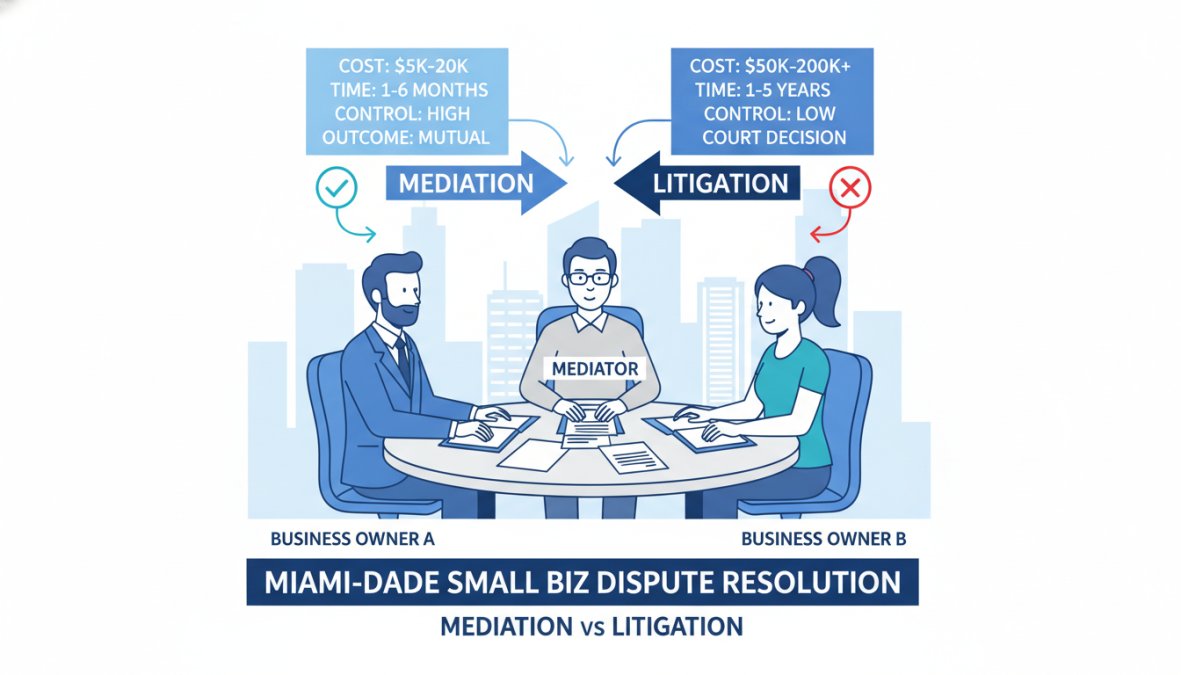
Many small business owners agree to mediation without first consulting counsel and then make binding concessions they later regret. Mediation is not informal, agreements reached are enforceable contracts. Always have legal representation before you sit down at the mediation table.
Cost of Business Litigation in Florida: A Realistic Breakdown
The cost of business litigation in Florida is consistently underestimated. Attorney fees, court filing costs, expert witness fees, deposition costs, and management time diverted from operations all compound quickly. Florida follows the American Rule, each party pays its own attorney fees unless a contract provision, statute, or court order shifts fees to the losing party. The Florida Deceptive and Unfair Trade Practices Act and certain other statutes allow fee-shifting, which can be a significant factor in litigation strategy.
| Litigation Phase | Approximate Cost Range | Key Variables |
|---|---|---|
| Pre-litigation demand and evaluation | Lower range | Case complexity, document volume |
| Filing and early motions | Moderate range | Court fees, motion practice |
| Discovery and depositions | Higher range | Number of witnesses, document review |
| Mediation | Moderate range | Mediator rates, session length |
| Trial | Highest range | Length, expert witnesses |
The takeaway: mediation at the right moment is almost always cheaper than trial. The question is whether the other side will negotiate in good faith.
Step-by-Step Guide to Filing a Commercial Case in Miami-Dade Court
Filing a commercial case in Miami-Dade County follows a defined sequence, and errors create delays that can cost months. Most commercial matters must be filed electronically through the Florida Courts E-Filing Portal.

Here is the standard sequence:
- Evaluate your claims and identify the correct court: Small Claims Court (up to $8,000), County Civil Division, or Circuit Civil Division (claims over $50,000).
- Draft and review the complaint: Identify the parties, state the facts, specify each legal cause of action, and state the relief requested. Errors here can result in dismissal.
- File through the Florida Courts E-Filing Portal: Pay the required filing fee, which varies by claim amount and court division.
- Serve the defendant: Florida requires proper service of process under Florida Rule of Civil Procedure 1.070. Improper service can void the entire case.
- Await the defendant’s response: The defendant has 20 days to respond after service. Failure to respond allows you to seek a default judgment.
- Engage in case management: The assigned judge will issue a case management order setting deadlines for discovery, motions, and trial.
- Complete discovery: Exchange documents, take depositions, and respond to interrogatories within the court’s schedule.
- Attend mediation: Florida courts require mediation before trial in most civil cases.
- Proceed to trial or settlement: Most cases resolve before trial. If not, present your case to the judge or jury.
According to Florida Courts official case management guidelines, the Eleventh Judicial Circuit has implemented differentiated case management tracks that set firm timelines for commercial cases, reducing time from filing to resolution.
Small Claims Court vs Civil Court: Choosing the Right Venue
Small Claims Court handles disputes up to $8,000 with simplified procedures, faster hearings, and lower filing fees. Civil Court operates under the full Florida Rules of Civil Procedure, with greater complexity and longer timelines. For most small business disputes above $8,000, the Circuit Civil Division is the appropriate venue. Filing in the wrong division wastes time and fees, the case will be transferred, adding delay and cost.
Pre-Litigation Risk Mitigation: What Smart Business Owners Do First
The most effective strategy in miami-dade small business litigation is avoiding it. A pre-litigation risk mitigation checklist should be reviewed annually:
- Review and update your LLC operating agreement or shareholder agreement, including deadlock provisions and buyout mechanisms
- Audit all vendor, client, and service contracts for clear performance standards and dispute resolution clauses
- Confirm that all employees with access to sensitive information have signed confidentiality and non-disclosure agreements
- Review your commercial lease for assignment rights, renewal options, and landlord default remedies
- Verify that all business decisions are properly documented in meeting minutes or written resolutions
- Confirm that corporate formalities are being maintained to protect against personal liability
- Identify any existing disputes or potential claims and consult counsel before they escalate
The single most effective risk mitigation tool for small businesses is a well-drafted LLC operating agreement that addresses deadlock, member exit, and dispute resolution before a conflict arises. Fixing these provisions after a dispute begins is expensive, contentious, and often impossible.
Reviewing Your LLC Operating Agreement and Commercial Lease Disputes
LLC operating agreements determine how disputes between members are handled, how management decisions are made, and what happens when a member wants to exit. Florida’s default LLC rules under Chapter 605 fill gaps where the agreement is silent, but those defaults are not always favorable to minority members or departing partners.
Commercial lease disputes are among the most financially damaging matters in miami-dade small business litigation. Personal guarantees, CAM charge disputes, exclusive use clause violations, and co-tenancy provisions all generate litigation. According to Florida Bar guidance on commercial lease disputes, commercial tenants in Florida have fewer statutory protections than residential tenants, making careful pre-signing review critical. Do not sign a commercial lease without having counsel review it first.
How Miami-Dade Small Business Litigation Differs From Other Markets
Miami-Dade County presents a commercial litigation environment genuinely distinct from other Florida markets. The Eleventh Judicial Circuit is one of the busiest court systems in the country, meaning case management timelines can be longer than in smaller Florida counties. Local counsel with direct circuit experience and familiarity with specific judges’ preferences is a strategic asset, not a luxury.
The South Florida business community is heavily international, with many disputes involving parties from Latin America, Europe, or the Caribbean, introducing questions of jurisdiction, service of process abroad, and enforcement of foreign judgments. The concentration of industries, hospitality, real estate, healthcare, and international trade, means real estate litigation, commercial lease disputes, and franchise law matters appear with particular frequency. As documented in American Bar Association guidance on local counsel practices, use of local counsel in complex commercial matters is a recognized best practice for exactly this reason.
If you are a Coral Springs or Broward County business owner with a dispute involving a Miami-Dade counterparty, your case may need to be filed in the Eleventh Judicial Circuit even if your business is not located there. Jurisdiction follows the defendant, not the plaintiff, in most commercial matters.
Small business disputes in South Florida move fast, and the decisions you make in the first days of a conflict often determine the outcome. Matthew Fornaro, P.A. brings over two decades of experience representing entrepreneurs and small business owners in commercial litigation, contract disputes, and business formation matters across Coral Springs, Parkland, and the broader South Florida region. If your business is facing a dispute or you want to put stronger protections in place before one arises, call Matthew Fornaro, P.A. today for a direct conversation about your situation.
Frequently Asked Questions
What are the most common types of small business litigation in Miami-Dade?
The most common types of Miami-Dade small business litigation include breach of contract claims, partnership disputes, shareholder conflicts, commercial lease disputes, debt collection actions, and breach of fiduciary duty cases. Business divorce proceedings and trade secret misappropriation claims are also frequently filed in the Eleventh Judicial Circuit. The specific mix often depends on the industry and business structure involved, making early consultation with local counsel essential to assess your situation accurately.
Can I resolve a business dispute without going to court in Florida?
Yes. Florida courts generally encourage alternative dispute resolution before trial. Mediation and arbitration are both viable options for business dispute resolution and can save significant time and money compared to full commercial litigation. Many LLC operating agreements and commercial contracts include mandatory arbitration clauses. A qualified attorney can review your agreements to determine whether ADR is required or advisable before pursuing a lawsuit in Miami-Dade County civil court.
What is the statute of limitations for breach of contract in Florida?
In Florida, the statute of limitations for a written breach of contract lawsuit is generally five years from the date of the breach. For oral contracts, the limit is four years. Missing this deadline typically bars your claim entirely, so it is critical to consult an attorney as soon as you suspect a breach. Florida statutes may also affect tolling provisions depending on the circumstances, which is another reason to seek legal counsel promptly.
How much does it cost to hire a business litigation attorney in Miami?
The cost of business litigation in Florida varies widely based on case complexity, attorney experience, and whether the matter settles early or goes to trial. Hourly rates for commercial litigation attorneys in Miami-Dade can range considerably, and total costs including court fees, discovery, and expert witnesses can escalate quickly. Many firms offer initial consultations to help you understand likely costs. Weighing litigation costs against potential recovery is a key part of building a sound litigation strategy.
How long does a business lawsuit take in Miami-Dade County courts?
The timeline for Miami-Dade small business litigation depends on case complexity and court scheduling. Simple contract disputes resolved through mediation may conclude in a few months, while contested commercial litigation proceeding through the Eleventh Judicial Circuit to trial can take one to three years or longer. Case management conferences, discovery disputes, and motion practice all affect timing. An experienced local counsel can give you a realistic timeline estimate based on the current docket and your specific facts.
This article was written using GrandRanker


