

Key Takeaways
- Florida business law protects companies from unfair competition, contract breaches, and partner disputes.
- Acting early saves time, money, and business relationships.
- An experienced business attorney helps you assess risk and choose the right legal strategy.
Every small business owner will face a business dispute at some point. Whether it’s a vendor who didn’t deliver, a partner who wants out, or an employee claiming wrongful termination, these conflicts are a normal part of running a company. The good news? A dispute doesn’t have to mean a lawsuit. Most disagreements, formally called commercial disputes in legal practice, can be resolved without ever setting foot in a courtroom. This guide breaks down the types of business disputes, how to resolve them, and what you can do right now to prevent them from getting out of hand.
Table of Contents
- Key takeaways
- What is a business dispute and why does it matter?
- Types of business disputes you need to know
- Dispute resolution methods compared
- How to prevent disputes before they happen
- What to do when a dispute arises
- My take on business disputes after 20 years
- Protect your business before conflict finds you
- FAQ
Key takeaways
| Point | Details |
|---|---|
| Disputes are inevitable | Every business will face conflict; knowing how to respond matters more than avoiding it entirely. |
| Prevention starts with contracts | Clear, written agreements and documented policies eliminate most common business disagreements before they start. |
| Litigation isn’t your only option | Mediation, arbitration, and hybrid approaches often resolve disputes faster and at a lower cost than court. |
| Act early when conflict arises | Consulting a legal professional at the first sign of a dispute protects your position and your options. |
| Document everything | Keeping thorough communication records is one of the most powerful tools you have during any dispute. |
What is a business dispute and why does it matter?
A business dispute is any disagreement between two or more parties that arises from a commercial relationship. That relationship might be between business partners, an employer and employee, a vendor and a client, or a company and its customers. The disagreement can involve money, obligations, ownership rights, or conduct. It doesn’t have to involve a lawyer or a courtroom to qualify as a dispute.
What trips up many small business owners is the assumption that disputes are rare or dramatic. They aren’t. Common business disagreements arise constantly from contract breaches, partnership tensions, employment conflicts, intellectual property issues, and customer claims. A client who refuses to pay an invoice. A co-founder who wants to take the company in a different direction. A former employee who files a discrimination claim. These are all business disputes, and they happen to companies of every size.
The stakes for small businesses are particularly high. You don’t have the legal budget or the operational slack that a large corporation does. A single unresolved dispute can drain cash, damage your reputation, and consume months of your attention. Understanding what you’re dealing with early is the first and most important step toward handling it well.

Types of business disputes you need to know
Not all disputes are equal. They vary in complexity, legal exposure, and the best path to resolution. Here’s a breakdown of the categories small business owners most commonly face.
-
Contract disputes are the most frequent type. They occur when one party claims the other didn’t fulfill their obligations under a written or verbal agreement. Common triggers include missed deadlines, defective goods, unpaid invoices, and disagreements about the scope of work. Even well-intentioned contracts can generate conflict if the terms were vague.
-
Partnership and shareholder conflicts tend to be the most emotionally charged. Disagreements over profit sharing, management decisions, expansion plans, or exit strategy can fracture a business. Without a solid operating agreement or shareholders’ agreement in place, these disputes often get expensive fast.
-
Employment disputes cover a wide range of conflicts between employers and employees or job applicants. Types of employment-related business disputes include wrongful termination claims, discrimination allegations, wage disputes, non-compete enforcement, and harassment complaints. These carry significant legal risk and often involve regulatory agencies like the EEOC.
-
Intellectual property disputes arise when someone uses your trademark, copies your content, or infringes on a patent you hold. They can also work in reverse, with a competitor or licensing partner claiming you’ve used their IP without authorization.
-
Customer and warranty claims involve disputes over the quality of a product or service. A customer who believes they were misled or received a defective product may escalate to a formal complaint, a chargeback, or a lawsuit if the issue isn’t resolved quickly.
-
Business valuation disputes often surface during partnership dissolutions, buyouts, mergers, or estate matters. What is a business valuation dispute, exactly? It’s a conflict over what a business is worth, and it almost always requires expert analysis to resolve.
Pro Tip: If you don’t have a written operating agreement or partnership agreement, get one now. Even if the relationship feels solid, a clearly documented agreement is the single best protection against the most costly disputes in this list.
Dispute resolution methods compared
When a dispute arises, you have more options than you might think. Litigation gets all the attention, but it’s often the worst choice for small businesses. The legal aspects of business disputes include several recognized resolution processes, each suited to different situations.
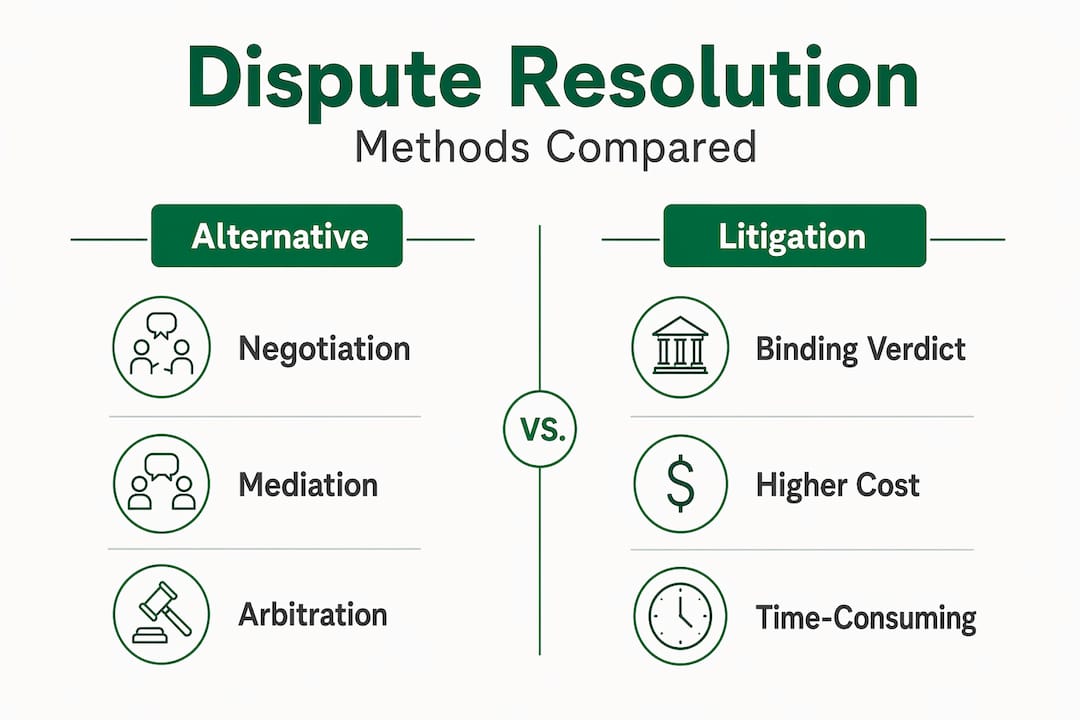
Here’s a side-by-side look at your main options:
| Method | Binding? | Cost | Time | Relationship preserved? |
|---|---|---|---|---|
| Negotiation | No | Very low | Days to weeks | Yes |
| Mediation | No | Low to moderate | Weeks | Yes |
| Arbitration | Yes | Moderate | Months | Sometimes |
| Med-arb | Yes (if needed) | Moderate | Weeks to months | Often |
| Litigation | Yes | High | Months to years | Rarely |
Mediation uses a neutral third party to help both sides explore options and reach a voluntary, non-binding agreement. Nothing is imposed. The mediator facilitates conversation, identifies common ground, and helps parties craft a resolution they both own. It’s especially effective when the business relationship is worth preserving.
Arbitration takes a more formal approach. A neutral arbitrator hears evidence from both sides and then renders a binding, typically confidential decision that is rarely appealable. It’s faster and cheaper than court, but you give up control of the outcome.
Med-arb is a hybrid process that combines mediation and arbitration: parties start with mediation, and if they can’t reach agreement, the same neutral transitions into an arbitrator and issues a binding decision. This approach is frequently overlooked by business owners, but it’s one of the most practical tools available. You get the relationship-preserving benefits of mediation with the certainty of arbitration as a backstop.
Litigation belongs on the table when the dispute involves significant financial exposure, the other party is acting in bad faith, or legal precedent needs to be set. But non-litigation resolution saves small businesses both courtroom expenses and public exposure. Court records are public, legal fees add up fast, and a case can drag on for years.
Knowing which resolution process fits your goals is critical. Preserving a valuable client relationship? Mediation. Need a final, enforceable answer? Arbitration or med-arb. The right choice depends on what outcome matters most to you. For a deeper look at how these two paths compare, the mediation and arbitration breakdown at Fornarolegal is worth reading.
Pro Tip: If you include an arbitration clause in your contracts, specify the rules and venue in advance. Vague clauses create their own disputes about how the dispute gets resolved.
How to prevent disputes before they happen
Prevention is always cheaper than resolution. Most disputes don’t appear out of nowhere. They grow from unclear expectations, missing documentation, or policies that nobody bothered to put in writing. Here’s how to close those gaps before they become problems.
-
Write everything down. Verbal agreements feel easier in the moment, but they are nearly impossible to enforce. Every significant business relationship, from vendor contracts to partnership terms, should be documented in a signed written agreement with clear obligations, deadlines, and remedies.
-
Use standard forms consistently. Standard contracts and policies reduce the risk of misunderstandings and make it easier to resolve disagreements when they do arise. Don’t reinvent the wheel for every transaction.
-
Build an employment policy framework. Types of employment-related business disputes are among the most expensive to resolve. A clear employee handbook covering hiring, discipline, termination, and anti-harassment policies gives you a documented foundation that protects both you and your staff.
-
Get waivers and disclosures in writing. For service businesses especially, having customers acknowledge the scope of work, the limitations of your service, and any relevant risks in writing can stop a complaint from becoming a lawsuit.
-
Consult a legal professional early. Early legal guidance is one of the most effective investments a small business can make. Having an attorney draft or review your core agreements before problems arise is far less expensive than hiring one to fix the damage after the fact. Proactive legal strategies are especially important for Florida businesses navigating state-specific regulations.
Pro Tip: Review your key contracts once a year. Your business changes, your relationships change, and your agreements should reflect both. A contract you signed three years ago may no longer protect you the way you think it does.
What to do when a dispute arises
Even with solid prevention in place, conflicts happen. When one lands in your lap, the way you respond in the early stages matters enormously.
-
Assess severity before reacting. Not every dispute needs a lawyer on day one. Understand what’s actually at stake, whether it’s a contractual obligation, a financial claim, or a relationship, before deciding how to respond.
-
Document every interaction immediately. Save emails, texts, contracts, invoices, and any other relevant records. Detailed communication records are often the deciding factor in how a dispute resolves. Start building that file the moment the conflict surfaces.
-
Consult a legal professional early. Even a single consultation can clarify your rights, your exposure, and your best options. Waiting too long often limits what you can do.
-
Keep communication professional. Disputes are frustrating, but emotional responses in writing create evidence that works against you. Stay factual. Stay calm.
-
Explore alternatives before filing suit. Most parties want to avoid litigation. Open a dialog about mediation or direct negotiation. You may find the other side is more willing to compromise than their initial position suggests.
-
Prepare thoroughly if litigation is necessary. If the dispute requires court, work with your attorney to organize your documentation, understand your timeline, and set realistic expectations. Preparation, not emotion, wins cases.
My take on business disputes after 20 years
I’ve handled hundreds of commercial disputes over my career, and the pattern I see most often is a business owner who waited too long. They hoped the problem would resolve itself. They didn’t want to “make things worse” by bringing in an attorney. By the time they called me, a dispute that could have been mediated in a few sessions had turned into full litigation with real money on the line.
The other thing I’ve learned is that the legal aspects of business disputes are often secondary to the emotional ones. Business owners take conflicts personally, especially with partners or long-term vendors. That’s understandable, but it clouds judgment. The fastest path to resolution is almost always the one where you separate the relationship from the outcome you need.
What genuinely works? Acting early, staying organized, and being honest with yourself about what you’re willing to accept. I’ve seen clients walk away from litigation that they would have won because the time and cost weren’t worth it. I’ve also seen clients fight for the right outcome and get it because they were prepared. Neither path is wrong. But both require clear thinking from the start, not from the point of desperation.
Prevention never feels urgent until a dispute hits. I push every client to treat their contracts and policies like the most important business asset they have. Because when things go wrong, they are.
— Matthew
Protect your business before conflict finds you

Business disputes are expensive, time-consuming, and stressful, but many are entirely preventable. At Fornarolegal, we work with small businesses, startups, and entrepreneurs across South Florida to draft airtight contracts, build employment policies that hold up, and respond strategically when conflicts do arise. If you’re already facing a dispute, we can walk you through your options for avoiding costly litigation and help you choose the resolution path that protects your interests. Don’t wait for a conflict to get out of hand. The earlier you get sound legal guidance, the more options you have.
FAQ
What is a business dispute?
A business dispute is a formal or informal disagreement between parties in a commercial relationship, covering contracts, employment, partnerships, intellectual property, or customer claims. It may or may not involve legal proceedings.
What are the most common types of business disputes?
Common dispute types include contract breaches, partnership conflicts, employment claims, intellectual property issues, and customer warranty complaints. Contract disputes are the most frequent category for small businesses.
How do you resolve a business dispute without going to court?
Mediation and arbitration are the two primary alternatives to litigation. Mediation is voluntary and non-binding. Arbitration produces a binding decision. A med-arb hybrid approach combines both and is particularly effective when parties want flexibility with a guaranteed resolution.
What is a business valuation dispute?
A business valuation dispute is a conflict over how much a business is worth, typically arising during partner buyouts, divorce proceedings, or business sales. These disputes almost always require a certified business appraiser to resolve.
When should I consult a lawyer about a business dispute?
Consult a lawyer as early as possible. Early legal guidance helps you understand your rights, preserve your options, and often prevents a manageable disagreement from escalating into costly litigation.
Recommended
- Business Dispute Lawyers: A Guide to Resolving Commercial Conflicts » Matthew Fornaro, P.A.
- How to Protect Your Business When a Dispute Is Just Beginning » Matthew Fornaro, P.A.
- Top Legal Strategies to Prevent Business Disputes in Florida: A Guide for Small and Medium Businesses » Matthew Fornaro, P.A.
- Arbitration vs. Litigation in Florida: A Practical Guide for Business Owners » Matthew Fornaro, P.A.


