

Key Takeaways
- Florida business law protects companies from unfair competition, contract breaches, and partner disputes.
- Acting early saves time, money, and business relationships.
- An experienced business attorney helps you assess risk and choose the right legal strategy.
Business formation is the legal process of creating a separate business entity that protects your personal assets by separating them from business liabilities. For South Florida entrepreneurs, understanding this process is the difference between building on solid legal ground and exposing everything you own to business risk. The standard industry term is “business entity formation,” and it covers far more than just filing paperwork. It defines your tax structure, your liability exposure, and how you can raise capital. The IRS, the U.S. Small Business Administration, and the Florida Department of State each play a role in the process, which typically takes 2–8 weeks from start to finish.
What is business formation and why does it matter?
Business formation is defined as the legal act of registering a business as a recognized entity under state and federal law. That registration creates a boundary between your personal finances and your business operations. Without it, a lawsuit against your business is a lawsuit against you personally.
Well-structured entities attract investors and lenders far more easily than informal arrangements. That credibility gap is real, and it shows up early. A Miami contractor operating as a sole proprietor, for example, cannot easily open a business line of credit or sign a commercial lease on favorable terms. A registered LLC or corporation changes that picture immediately.

Formation also determines how the IRS taxes your income. Sole proprietorships file taxes on personal returns, while corporations may face corporate tax unless they elect S corporation status. Getting this right from day one prevents expensive restructuring later.
What are the main types of business entities?
The four most common structures in the U.S. are sole proprietorships, partnerships, LLCs, and corporations. Each one affects liability, taxation, and daily operations differently.
| Entity type | Liability protection | Tax treatment | Best for |
|---|---|---|---|
| Sole proprietorship | None | Personal return | Freelancers, low-risk solo work |
| General partnership | None | Pass-through to partners | Small co-owned businesses |
| LLC | Yes | Pass-through (flexible) | Most small businesses |
| Corporation (C or S) | Yes | Corporate or pass-through | Growth-focused, investor-ready |
Sole proprietorships leave owners personally liable for every debt and lawsuit. That simplicity comes at a steep price. A single slip-and-fall at your Fort Lauderdale shop, or a contract dispute with a vendor, can wipe out your personal savings if you have no legal shield.
LLCs are the most popular choice for South Florida small business owners because they combine liability protection with flexible management and pass-through taxation. Corporations offer stronger credibility with investors and allow stock issuance, but they require more formal governance, including annual meetings and detailed record-keeping.
Pro Tip: If you are unsure between an LLC and an S corporation, compare your projected net income against self-employment tax savings. At higher income levels, an S corp election can reduce your tax burden meaningfully. A business attorney can run those numbers with you before you file.
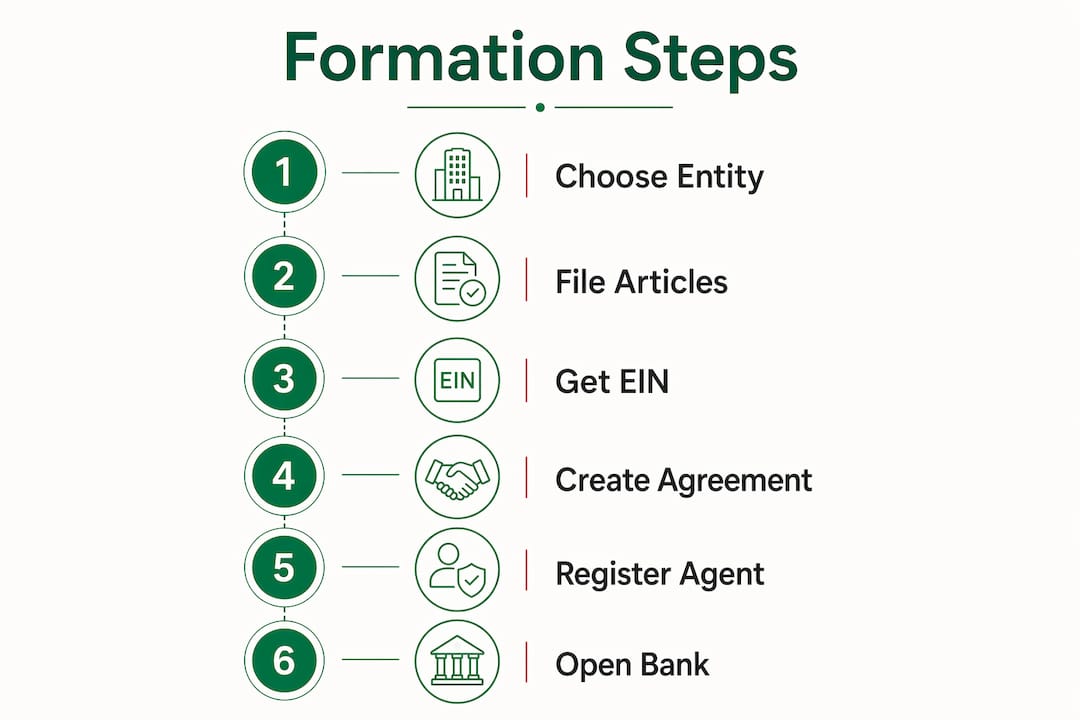
How to form a business in Florida: the essential steps
Florida has a clear business registration process, but skipping any step creates gaps that can cost you later. Here is the sequence every South Florida entrepreneur needs to follow.
-
Choose and verify your business name. Your name must be unique in Florida’s records. Search the Florida Division of Corporations database at Sunbiz.org before committing. A name conflict forces a costly rebrand after launch.
-
Designate a Registered Agent. Florida law requires every LLC and corporation to name a registered agent. This person or service receives legal documents and official notices on your behalf during business hours. Using yourself as agent puts your personal address on the public record permanently.
-
File your formation documents with the Florida Department of State. LLCs file Articles of Organization. Corporations file Articles of Incorporation. Both can be submitted online through Sunbiz.org. Filing fees vary by entity type, so confirm current amounts directly with the Florida Division of Corporations.
-
Obtain an Employer Identification Number (EIN) from the IRS. An EIN is your business’s federal tax ID. EINs are free from the IRS website if you have a valid Social Security number. You need an EIN to open a business bank account, hire employees, and file business taxes.
-
Draft your Operating Agreement or Bylaws. Florida does not always require these documents, but operating without them leaves your governance rules to default state law. Default rules rarely match what founders actually want.
-
Register for state and local licenses. Depending on your industry and city, you may need a Florida business license, a local occupational license, or both. Miami-Dade, Broward, and Palm Beach counties each have their own requirements.
Pro Tip: Use a professional registered agent service instead of listing your home address. It costs less than $200 per year in most cases and keeps your personal address off Florida’s public business registry permanently.
For a detailed walkthrough of the Florida formation process, Fornarolegal has published a step-by-step legal guide built specifically for South Florida business owners.
Why proper formation protects you and what happens without it
The core benefit of business formation is the corporate veil. This legal concept separates your personal assets from your business debts and lawsuits. Courts will honor that separation only if you maintain it properly.
Maintaining the corporate veil requires disciplined practices: separate bank accounts, separate credit cards, accurate financial records, and timely annual state filings. Mixing personal and business finances is the single most common reason courts pierce the corporate veil and hold owners personally liable.
The benefits of proper formation include:
- Personal asset protection. Your home, car, and savings stay out of reach in a business lawsuit.
- Tax flexibility. LLCs and S corporations allow income to pass through to personal returns, avoiding double taxation.
- Credibility with lenders and investors. Registered entities qualify for business loans, lines of credit, and investor funding.
- Clear governance. Operating agreements and bylaws define who makes decisions and how disputes get resolved.
- Continuity. A properly formed entity survives ownership changes; a sole proprietorship dissolves when the owner exits.
The risks of skipping or rushing formation are equally concrete:
- Personal liability for all business debts and legal judgments
- Loss of the legal shield if corporate formalities are ignored
- Tax penalties from incorrect entity classification
- Difficulty raising capital or signing commercial contracts
- Costly legal restructuring if you need to change entity types later
Changing entity types after formation involves complex legal procedures and fees. Getting the structure right at the start is far cheaper than fixing it under pressure.
How to choose the right business entity for your South Florida startup
The right entity depends on your specific goals, not on what your neighbor or fellow entrepreneur chose. Aligning formation choices with long-term financial and operational goals from the start prevents expensive conversions down the road.
Key factors to weigh before you file:
- Liability exposure. How much personal risk does your business activity carry? A construction company in Broward County carries far more liability than a solo graphic designer.
- Tax treatment. Do you want pass-through taxation or are you planning to retain earnings inside the business?
- Management structure. Will you have partners or investors who need defined roles and voting rights?
- Funding plans. If you plan to raise outside capital, a corporation with stock issuance rights is often the better fit.
- Growth expectations. A business you plan to sell in five years needs a structure that supports clean acquisition due diligence.
South Florida’s economic environment adds specific considerations. The region’s large international business community means many owners deal with cross-border contracts and foreign investors. Florida also has no state income tax, which makes pass-through structures particularly attractive. Local industry concentrations in real estate, hospitality, healthcare, and logistics each carry distinct liability profiles that should shape your entity choice.
Fornarolegal’s guide on choosing the right entity in Florida covers these factors in detail, including the legal risks tied to each structure.
Key Takeaways
Business formation is the legal foundation every South Florida entrepreneur needs before signing a contract, hiring staff, or accepting a dollar of revenue.
| Point | Details |
|---|---|
| Formation creates legal separation | A registered entity shields your personal assets from business debts and lawsuits. |
| Entity type determines tax treatment | LLCs and S corps use pass-through taxation; C corporations face corporate-level tax. |
| Florida requires a registered agent | Every LLC and corporation must name an agent to receive legal notices on its behalf. |
| Corporate veil requires maintenance | Separate finances, accurate records, and annual filings keep your liability shield intact. |
| Early planning prevents costly changes | Choosing the wrong structure at the start means complex legal procedures to fix it later. |
What I have learned after 20 years of South Florida business formation work
The most expensive mistake I see is not choosing the wrong entity. It is treating formation as a one-time checkbox rather than an ongoing legal obligation.
Entrepreneurs file their Articles of Organization, get their EIN, and then never draft an Operating Agreement. Six months later, a co-founder dispute erupts and there are no written rules for how decisions get made or how one partner can exit. At that point, Florida’s default LLC statutes take over, and those rules almost never match what the founders actually intended. I have seen partnerships dissolve over exactly this scenario, and the legal fees to untangle it dwarf what a proper Operating Agreement would have cost at the start.
The second pattern I see constantly is personal finances bleeding into business accounts. An owner pays a personal bill from the business account “just this once.” Then it happens again. A year later, if that business faces a lawsuit, opposing counsel will use those records to argue the corporate veil should be pierced. Courts in Florida take this seriously. The protection you paid to create disappears because of sloppy bookkeeping.
My honest advice: treat your formation documents and your financial separation as the two non-negotiable pillars of your business. Everything else, including marketing, hiring, and growth, builds on top of those two things. If they are weak, the whole structure is exposed. Get them right first, and get legal guidance before you file, not after a problem surfaces.
— Matthew
Legal guidance for South Florida business owners
Starting a business in South Florida without proper legal guidance is one of the most common and costly mistakes new entrepreneurs make. Formation errors are far easier to prevent than to fix.

Fornarolegal works with entrepreneurs, startups, and established businesses across South Florida to get formation right from day one. Matthew Fornaro brings over 20 years of court-tested experience to every engagement, from entity selection and Operating Agreement drafting to ongoing compliance and preventing business litigation before it starts. If you are ready to form your business on solid legal ground, or if you need to review an existing structure for gaps, contact Fornarolegal to schedule a consultation.
FAQ
What is business formation in simple terms?
Business formation is the legal process of registering a business as a separate entity under state and federal law. It protects your personal assets and defines how your business is taxed and governed.
What is the most common business structure for small businesses?
The LLC is the most common structure for small businesses because it combines personal liability protection with flexible pass-through taxation and simpler management requirements than a corporation.
How long does business formation take in Florida?
The formation process typically takes 2–8 weeks depending on the entity type and how quickly you complete each step, including filing with the Florida Department of State and obtaining an EIN from the IRS.
Do I need an Operating Agreement for my Florida LLC?
Florida does not always mandate an Operating Agreement, but operating without one leaves your LLC governed by default state rules that may not reflect your intentions. Drafting one at formation is strongly recommended.
What happens if I skip business formation and operate informally?
Operating without a registered entity means you have no liability shield. Every business debt, lawsuit, or contract dispute becomes a personal financial risk, and you may face tax penalties for incorrect income reporting.
Recommended
- Florida Business Formation Guide: LLC vs. Corporation vs. Partnership for South Florida Owners » Matthew Fornaro, P.A.
- Navigating Business Formation and Dissolution Laws in Florida: A Step-by-Step Guide » Matthew Fornaro, P.A.
- Florida Business Formation: A Step-by-Step Legal Guide for SMBs » Matthew Fornaro, P.A.
- Broward County Business Formation Services: A Lawyer’s Guide » Matthew Fornaro, P.A.


