

Key Takeaways
- Florida business law protects companies from unfair competition, contract breaches, and partner disputes.
- Acting early saves time, money, and business relationships.
- An experienced business attorney helps you assess risk and choose the right legal strategy.
Table of Contents
- Why You Need a Trademark Attorney for Registration
- Common Trademark Application Mistakes That Derail Registrations
- Understanding the Trademark Registration Process Timeline
- Conducting Comprehensive Trademark Search and Clearance Services
- Responding to Trademark Office Action: Why Professional Guidance Matters
- DIY vs. LegalZoom vs. U.S.-Licensed Attorney: What You Should Know
- Post-Registration Enforcement and Brand Protection
- Budget-Friendly Attorney Engagement Models for Small Business
Last Updated: June 23, 2026
Understanding why you need a trademark attorney for registration is one of the most consequential decisions a business owner can make when building a brand. At Matthew Fornaro, P.A., we’ve guided South Florida entrepreneurs through the USPTO registration process for over two decades. The pattern is consistent: applicants who skip professional legal counsel face significantly higher rejection rates, costly office actions, and registration failures that leave their brands unprotected. Federal trademark registration is not a form-filling exercise. It is a legal proceeding with strict procedural requirements, substantive legal standards, and long-term consequences for your intellectual property rights.
Common Trademark Application Mistakes That Derail Registrations
Most trademark applications fail not because the brand is unregistrable, but because the application itself is flawed. The USPTO trademark examiner reviews every application against detailed statutory requirements, and even minor errors can result in refusal or costly delays.
Incorrect Goods and Services Classification
Trademark registration requires applicants to identify their goods and services using the USPTO’s international classification system, which organizes products and services into 45 distinct classes. Selecting the wrong class or describing goods and services too narrowly or too broadly creates problems difficult to correct after filing.
A description that is too broad invites a likelihood of confusion refusal because it overlaps with existing registrations. A description that is too narrow leaves your brand exposed in categories where you actually operate. The USPTO’s identification of goods and services must be specific, definite, clear, and accurate.
Inadequate Specimen of Use Submission
A specimen of use is evidence that your trademark is actually being used in commerce in connection with the identified goods or services. This is not a logo file or business card. It is proof of real commercial use, such as product packaging, a website screenshot showing the mark during a purchase, or signage.
The USPTO rejects specimens that fail to show the mark as consumers would encounter it during an actual transaction. Digital storefronts, mockups, and internal marketing materials are common failures. The rules governing acceptable specimens differ by goods versus services.
Submitting a rejected specimen triggers an office action. Failing to respond correctly and on time can result in abandonment of your entire application.
Failing to Respond to Office Actions
The trademark registration process includes a review period during which the examining attorney may issue an office action, a formal legal document identifying problems with the application. Office actions require a substantive written response within three months (extendable to six months for a fee). Many applicants either miss the deadline or submit responses that fail to address the examiner’s objections.
A non-final office action is an opportunity to correct deficiencies. A final office action typically requires either an appeal to the Trademark Trial and Appeal Board or a request for reconsideration, both requiring legal expertise.
Understanding the Trademark Registration Process Timeline
The trademark registration process timeline runs from initial filing through final registration, and it is longer than most business owners expect. After filing, the USPTO typically takes several months to assign an examining attorney and begin substantive review. If an office action issues, the clock resets. If the application is approved for publication, a 30-day opposition period follows during which third parties can challenge the registration.
Federal registration provides constructive notice to the entire country of your claim to the mark, which is critical for enforcing your rights against infringers. Common law rights arise from actual use, but they are geographically limited and harder to enforce. Planning your trademark registration process timeline around product launches, investment rounds, or franchise development is essential. According to USPTO trademark processing time data, the average pendency for a trademark application from filing to registration can exceed twelve months when office actions are involved.
Conducting Comprehensive Trademark Search and Clearance Services
Trademark search and clearance services are the foundation of any sound registration strategy. Before filing, a competent trademark attorney conducts a search to identify existing marks that could block your application or expose your business to infringement liability.
Beyond TESS: What Professional Searches Reveal
The USPTO’s Trademark Electronic Search System, known as TESS, is the public database most DIY filers rely on. Searching TESS is necessary but not sufficient. TESS only captures federally registered marks and pending applications. It does not capture common law rights, state registrations, trade names, or marks used in commerce but not yet registered.
A comprehensive trademark search examines federal registrations and pending applications, state trademark registrations across all 50 states, common law use through business directories and commercial databases, and international registrations that may affect U.S. commerce.
The likelihood of confusion analysis that follows a comprehensive search is a legal judgment call, not a database lookup. Two marks can look different and still be confusingly similar under the legal standard applied by trademark examiners and courts. This analysis requires training in trademark law and familiarity with how the USPTO and courts apply the relevant factors.
Run a preliminary TESS search before investing in brand development. If your mark is clearly blocked by an identical registration in the same class, you’ll save significant time and money by pivoting early. But treat that preliminary search as a first filter, not a clearance opinion.
Responding to Trademark Office Actions: Why Professional Guidance Matters
Responding to a trademark office action is where professional legal counsel delivers its clearest return on investment. An office action is not a rejection. It is an examiner’s formal statement of objections, and a well-crafted response can overcome most of them.
Common Office Action Scenarios and Solutions
Likelihood of confusion refusals are the most common substantive refusal. The examiner identifies one or more registered marks similar to yours covering similar goods or services. Overcoming this requires arguing that the marks are distinguishable in appearance, sound, meaning, or commercial impression, and that the goods or services are sufficiently different.
Merely descriptive refusals arise when the USPTO finds that your mark describes a feature, quality, or characteristic of your goods or services rather than identifying their source. Overcoming this requires arguing that the mark is suggestive rather than descriptive, or submitting evidence of acquired distinctiveness through long and exclusive use.
Specimen refusals require submitting a substitute specimen that meets the USPTO’s standards, along with a declaration of use.
Each scenario has established response strategies. Missing the nuances wastes the response opportunity and can result in a final refusal.
DIY vs. LegalZoom vs. U.S.-Licensed Attorney: What You Should Know
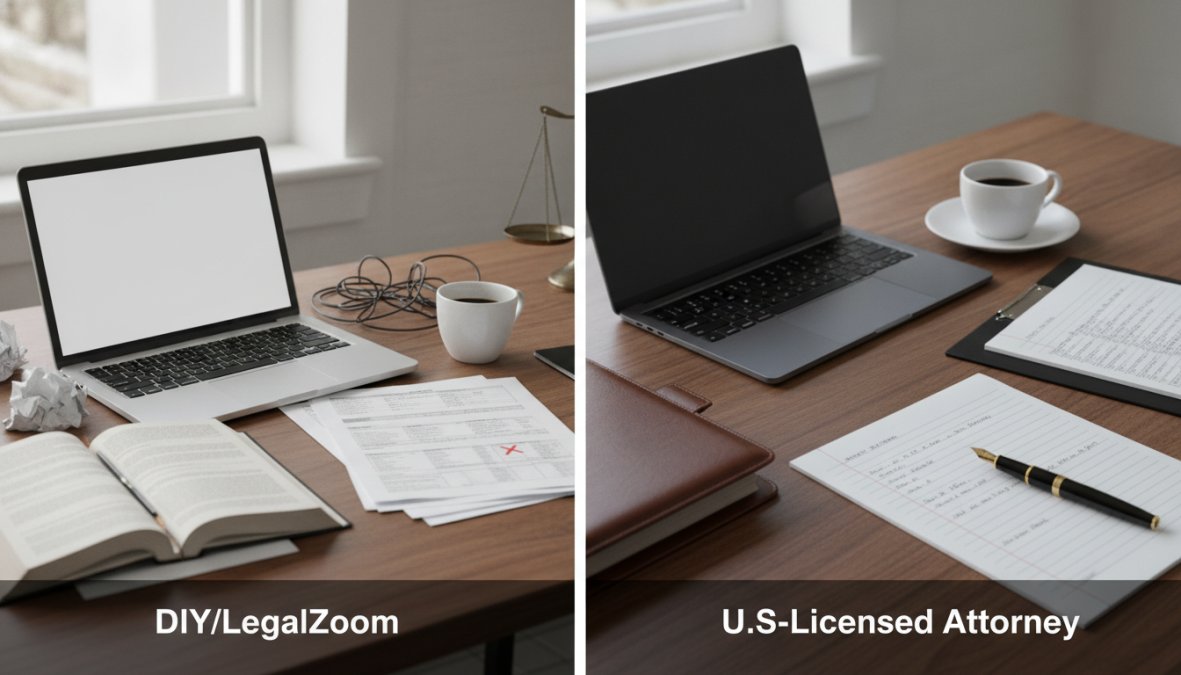
The decision between filing yourself, using a document preparation service, or retaining a U.S.-licensed attorney is really a question about how much risk your business can absorb.
Cost Comparison and Hidden Risks
| Filing Option | Upfront Cost | Office Action Support | Legal Advice | Risk Level |
|---|---|---|---|---|
| DIY (Pro Se) | USPTO fees only | None | None | Highest |
| LegalZoom / Third-Party Service | Moderate service fee | Limited / extra cost | None | High |
| U.S.-Licensed Attorney | Higher upfront | Included | Full | Lowest |
DIY filing carries the lowest upfront cost but the highest total risk. Filing fees are non-refundable. If your application is refused after examination, you lose those fees along with the time invested. A poorly constructed application can create a flawed registration that fails to protect what you actually need protected.
Document preparation services like LegalZoom occupy a middle tier. They can help with form completion, but they cannot provide legal advice, conduct a legal clearance analysis, or respond substantively to office actions. They are not law firms, and their service agreements typically disclaim responsibility for application outcomes.
A U.S.-licensed trademark attorney provides legal counsel, not just form preparation. The attorney analyzes clearance, crafts the application strategy, selects the appropriate filing basis, and represents you before the USPTO if problems arise. According to USPTO performance and accountability report, pro se applicants receive office actions at substantially higher rates than represented applicants, and their response success rates are lower.
The real cost of DIY trademark filing is not the filing fee. It is the cumulative cost of office action responses, potential refiling, and the months of unprotected brand exposure while the process drags on.
Post-Registration Enforcement and Brand Protection
Registration is not the finish line. A federal trademark registration certificate gives you the legal foundation to protect your brand, but enforcement requires active attention and ongoing legal strategy.
Why Registration Is Just the Beginning
Post-registration obligations include filing maintenance documents at regular intervals. Between the fifth and sixth year after registration, you must file a declaration of continued use. At the ten-year mark, you must file a renewal. Missing these deadlines results in cancellation of the registration.
Beyond maintenance, brand protection requires monitoring the trademark database for new applications that conflict with your mark. Early detection allows for a cease and desist letter before litigation becomes necessary. For businesses in Coral Springs and the broader South Florida market, local enforcement matters. A competitor operating nearby using a confusingly similar name or logo creates real commercial harm. Federal registration provides the legal tools to stop that conduct, but only if you act on it.
Budget-Friendly Attorney Engagement Models for Small Business
The assumption that trademark attorneys are only accessible to large companies is outdated. Many firms serving entrepreneurs near Coral Springs and throughout Broward County offer engagement models designed for small business realities.
Common budget-conscious approaches include flat-fee application packages that cover the search, application drafting, filing, and initial office action response for a fixed price; unbundled legal services, where the attorney handles specific tasks while the client handles other steps; and phased engagement, where the attorney advises on strategy and reviews the application before filing.
The right model depends on your budget, your risk tolerance, and the complexity of your mark. A qualified trademark attorney can assess that risk in an initial consultation and recommend the appropriate level of engagement. The question is not whether you can afford an attorney. The question is whether you can afford the consequences of proceeding without one.
Trademark registration mistakes are expensive, and many of them are irreversible within the original application. Matthew Fornaro, P.A. brings over two decades of experience helping South Florida entrepreneurs and small business owners protect their brands through the full registration process, from comprehensive clearance searches through post-registration enforcement. Our firm provides practical, results-oriented intellectual property counsel tailored to the needs of growing businesses in Coral Springs and across Broward County. Call today to discuss your trademark registration strategy.
Frequently Asked Questions
Can I register a trademark without an attorney?
Yes, you can file a trademark application yourself as a pro se applicant through the USPTO. However, DIY filers face higher rejection rates due to common mistakes in goods and services classification, specimen of use submission, and responding to office actions. An attorney increases your likelihood of successful federal registration and helps navigate statutory requirements that many business owners overlook.
What does a trademark attorney actually do during registration?
A U.S.-licensed trademark attorney conducts comprehensive trademark searches using TESS and other databases to assess likelihood of confusion, classifies your goods and services correctly, prepares your application strategy, gathers proper specimens of use, and responds to any office actions from the trademark examiner. They also provide legal advice on brand protection and help you understand your common law rights versus federal registration benefits.
What are the main risks of filing a trademark without legal help?
Common risks include incorrect classification leading to rejections, inadequate specimen of use submissions, failing to respond to office actions within required deadlines, and missing likelihood of confusion issues that could result in refusal. Without professional due diligence, you may also waste filing fees on applications that won't survive examination or fail to protect your full application scope.
How much does a trademark attorney cost versus DIY filing?
DIY filing through the USPTO costs around $250-350 per class. Attorney fees typically range from $800-2,500 for straightforward registrations, depending on complexity and location. While attorneys cost more upfront, they reduce the risk of expensive rejections, office action responses, and failed registrations. Many South Florida attorneys offer budget-friendly engagement models, including flat fees for standard applications.
This article was written using GrandRanker


