

Key Takeaways
- Florida business law protects companies from unfair competition, contract breaches, and partner disputes.
- Acting early saves time, money, and business relationships.
- An experienced business attorney helps you assess risk and choose the right legal strategy.
Table of Contents
- What Are Contract Disputes and Why They Happen
- Steps to Resolve a Business Contract Dispute
- Mediation vs Arbitration for Contracts: Which Path Is Right for You
- When to File a Lawsuit: Litigation as a Last Resort
- Contract Dispute Resolution Clause Examples That Actually Work
- How Long Does a Contract Dispute Take to Resolve
- Digital Evidence Management and the Psychology of Negotiation
- Conclusion
Last Updated: May 31, 2026
Contract dispute resolution is one of the most consequential legal challenges a business owner can face, and how you handle it determines whether you protect your interests or lose months of time and money. At Matthew Fornaro, P.A., we work with South Florida entrepreneurs and small business owners in Coral Springs and throughout Broward County who need practical, results-oriented guidance when contracts go wrong. This guide covers every stage of the resolution process, from the first demand letter to courtroom litigation, so you know exactly what to expect and when to act.
Here’s what most guides get wrong: they treat contract disputes as purely legal problems. They’re not. They’re negotiation problems with legal consequences. The path you choose in the first 30 days shapes everything that follows.
Below, we’ll show you exactly how to move through each resolution method, which one fits your situation, and how to use digital evidence and negotiation psychology to shift outcomes in your favor.
What Are Contract Disputes and Why They Happen
A contract dispute is a disagreement between two or more parties about the terms, performance, or enforceability of a binding agreement. These disputes arise when one party believes the other has failed to meet their contractual obligations, either partially or entirely.
The distinction matters immediately: not every disagreement rises to the level of a legal dispute. Many conflicts stem from ambiguous language, differing interpretations, or changed business circumstances, none of which automatically constitute a breach.
Common Causes of Contract Disputes in Commercial Contracts
Commercial contracts break down for predictable reasons. Understanding them helps you prevent disputes before they start and recognize them quickly when they do.
The most frequent causes include:
- Vague or missing terms: Contracts that fail to define deliverables, timelines, or payment schedules create room for interpretation conflicts
- Non-performance or late performance: One party fails to deliver goods, services, or payment on time
- Scope creep: Work expands beyond the original agreement without a formal amendment
- Misrepresentation: One party made claims during negotiation that proved false
- Changed circumstances: Economic shifts, supply chain disruptions, or regulatory changes make performance difficult or impossible
- Termination disputes: Disagreements about whether proper notice was given or grounds for termination existed
According to American Arbitration Association’s commercial dispute resources, the majority of commercial contract disputes involve payment-related issues, which reflects how often businesses operate on informal understandings rather than tightly drafted agreements.
The Difference Between a Minor Breach and a Material Breach
A minor breach (sometimes called a partial breach) occurs when a party substantially performs their obligations but falls short in a non-essential way. The non-breaching party can still claim damages but cannot typically treat the contract as terminated.
A material breach is a failure so significant that it defeats the purpose of the contract. A material breach gives the non-breaching party the right to suspend performance, terminate the agreement, and pursue legal remedies including damages and injunctive relief.
This distinction is critical because misclassifying a minor breach as material, and terminating a contract on that basis, can expose you to a counter-claim. Get the classification right before you act.
Terminating a contract based on a minor breach without legal counsel can flip the dispute: you become the breaching party. Always confirm the classification before stopping performance or withholding payment.
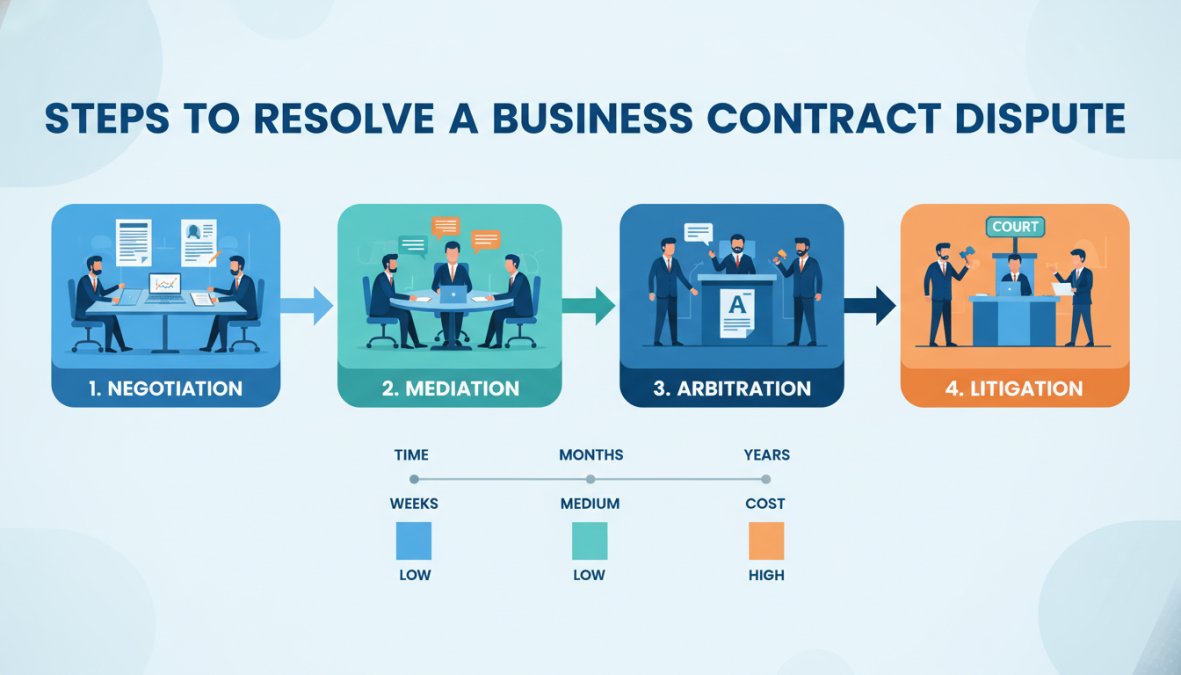
Steps to Resolve a Business Contract Dispute
The steps to resolve a business contract dispute follow a logical escalation path, starting with the least costly option and moving toward litigation only when necessary. Skipping steps doesn’t save time. It typically costs more in legal fees and damages your negotiating position.
Step 1: Review Contractual Terms and Notice Requirements
Start with the contract itself. Pull the original agreement, all amendments, and any written correspondence that could constitute a modification. Look specifically for:
- The dispute resolution clause (if one exists)
- Notice requirements: how disputes must be communicated, to whom, and within what timeframe
- The governing law and jurisdiction provisions
- Any statute of limitations language or cure periods
- Liquidated damages clauses that cap or define recovery
Many contracts require written notice of a dispute before any formal process can begin. Missing this step can invalidate your claim or trigger a procedural defense. Due diligence here takes an hour. Ignoring it can cost you the entire case.
Step 2: Send a Demand Letter in Good Faith
A demand letter is a formal written communication that states your position, identifies the breach, describes the harm, and requests a specific remedy by a specific date. It serves two purposes: it creates a documented record of your good faith effort to resolve the dispute, and it often prompts settlement without further escalation.
A strong demand letter includes:
- A clear statement of the contractual obligation at issue
- The specific conduct that constitutes the breach
- The damages or remedy you are seeking
- A reasonable deadline for response (typically 10-30 days)
- A statement that you will pursue further legal action if unresolved
Keep the tone professional. Threatening language weakens your position and can be used against you.
Step 3: Attempt Good Faith Negotiation Before Escalating
Good faith negotiation is not a formality. It’s often the fastest and cheapest path to resolution, and courts look favorably on parties who genuinely attempted it. Direct negotiation between principals, supported by legal counsel reviewing any proposed settlement, resolves a significant share of commercial disputes before formal ADR or litigation begins.
The goal at this stage is to reach a settlement agreement that both parties can live with. Document every communication. Every email, every phone call summary, every proposal exchanged becomes part of your evidentiary record if the dispute escalates.
Mediation vs Arbitration for Contracts: Which Path Is Right for You
Alternative dispute resolution (ADR) is the umbrella term covering methods that resolve disputes outside of court. The two primary forms are mediation and arbitration, and choosing between them is one of the most consequential decisions in the contract dispute resolution process.
| Method | Binding? | Cost | Timeline | Control |
|---|---|---|---|---|
| Mediation | No (typically) | Lower | Weeks to months | High: parties control outcome |
| Arbitration | Yes (typically) | Moderate to high | Months | Moderate: arbitrator decides |
| Litigation | Yes | Highest | 1-3+ years | Low: court decides |
Non-Binding Mediation: How It Works and When to Use It
Non-binding mediation is a facilitated negotiation process where a neutral third party (the mediator) helps the disputing parties reach a voluntary settlement. The mediator does not impose a decision. If the parties cannot agree, they leave the session free to pursue other options.
Mediation works best when:
- The parties have an ongoing business relationship they want to preserve
- The dispute involves interpretation differences rather than outright bad faith
- Speed and confidentiality are priorities
- Both sides have some flexibility on the outcome
The process typically involves a joint session where each side presents their position, followed by private caucuses where the mediator works with each party separately. A skilled mediator surfaces the underlying interests behind stated positions, which is where most settlements are actually built.
Choose a mediator with specific experience in commercial contracts, not just general civil disputes. A mediator who understands contract interpretation, liquidated damages clauses, and commercial damages calculations will move the process faster and surface more viable solutions.
Binding Arbitration: Enforceability, Costs, and Tradeoffs
Binding arbitration is a private adjudication process where an arbitrator (or panel) hears evidence and issues an arbitration award that is legally enforceable, much like a court judgment. Most commercial contracts include binding arbitration clauses that waive the parties’ right to a jury trial.
The enforceability of arbitration awards is well-established under the Federal Arbitration Act, as documented by Federal Arbitration Act overview. This makes arbitration a serious, final proceeding, not a preview of litigation.
The tradeoffs are real:
- Cost: Arbitrator fees, filing fees with organizations like the American Arbitration Association, and legal fees can rival litigation costs for complex disputes
- Discovery: The discovery process in arbitration is typically limited compared to court proceedings, which can disadvantage the party that needs more information
- Appeal rights: Grounds for appealing an arbitration award are extremely narrow, which means a bad outcome is largely final
- Speed: Arbitration generally resolves faster than court litigation, often within 6-18 months
When to File a Lawsuit: Litigation as a Last Resort
Litigation is the right choice when ADR has failed, when the other party is acting in bad faith, when injunctive relief is needed immediately, or when the dispute involves legal questions that require judicial interpretation. It is not the right first move, and experienced counsel will tell you the same.
That said, sometimes the threat of litigation is itself the tool that forces a reasonable settlement. Filing a complaint signals that you are serious and that the cost of continued non-compliance will exceed the cost of resolution.
But here is what most guides skip entirely: the decision to litigate is a financial decision before it is a legal one. Filing without running the numbers first is one of the most common and expensive mistakes small business owners make.
The Litigation Cost-Benefit Framework
Before authorizing your attorney to file, work through this framework. It will not make the decision for you, but it will prevent you from spending $80,000 in legal fees to recover $40,000 in damages, a scenario that plays out in commercial litigation regularly.
Step 1: Estimate Your Realistic Recovery
Start with the maximum damages you could theoretically recover, then apply a discount for litigation risk:
- What is the contract value or the documented loss? (This is your ceiling.)
- Does the contract include a fee-shifting clause that allows you to recover attorney’s fees if you prevail? If not, attorney’s fees come out of your recovery.
- Does the contract cap consequential damages or limit liability to a specific dollar amount? Many commercial contracts do.
- What is your honest assessment of the strength of your evidence? A strong paper trail with clear breach language warrants a higher confidence factor than a dispute hinging on verbal representations.
- Is the other party collectible? A judgment against a dissolved LLC or an insolvent defendant is worth the paper it is printed on.
Step 2: Estimate Your Realistic Litigation Cost
Litigation costs are front-loaded and largely non-recoverable if you lose. Typical cost categories for a commercial contract dispute in Florida state court include:
- Attorney’s fees: Hourly rates for commercial litigation attorneys in South Florida commonly range from the mid-hundreds to over $500 per hour depending on experience and firm size. A dispute that goes through discovery and trial can generate hundreds of hours of attorney time.
- Filing and service fees: Florida circuit court filing fees vary by claim amount but are generally a few hundred dollars at the outset.
- Expert witnesses: If your damages require expert testimony, a forensic accountant, an industry expert, expect additional costs per expert.
- Deposition costs: Court reporter fees, transcript costs, and attorney time for each deposition add up quickly in document-intensive disputes.
- Your own time: The hours you and your team spend gathering documents, sitting for depositions, and attending hearings have real opportunity cost even if they do not appear on a legal invoice.
Step 3: Apply the Go/No-Go Test
Use this simple decision filter before filing:
| Question | If YES | If NO |
|---|---|---|
| Is the realistic recovery at least 2x your estimated litigation cost? | Litigation may be viable | Explore ADR or settlement |
| Is the defendant collectible (assets, insurance, ongoing business)? | Proceed with analysis | Reconsider, a judgment may be uncollectable |
| Have you exhausted good faith negotiation and mediation? | Litigation is appropriate escalation | Return to ADR first |
| Does the dispute involve ongoing harm (IP theft, non-compete violation, contract interference)? | Injunctive relief may justify filing regardless of damages math | Damages-only disputes should clear the 2x threshold |
| Does your contract include a mandatory arbitration clause? | You may be required to arbitrate, not litigate | Litigation is available if no arbitration clause exists |
Filing a lawsuit to “send a message” without clearing the cost-benefit threshold is a strategy that benefits attorneys more than clients. If your goal is leverage, a well-drafted demand letter from counsel often creates the same pressure at a fraction of the cost.
Step 4: Consider the Non-Financial Costs
The cost-benefit framework above is purely financial. Litigation also carries costs that do not appear on invoices:
- Distraction: Commercial litigation demands significant attention from ownership and key employees during discovery, depositions, and trial preparation. For a small business, this distraction can affect operations and revenue in ways that dwarf the legal fees.
- Relationship destruction: Litigation is adversarial by design. If the other party is a vendor, customer, or partner you may need to work with again, filing a lawsuit typically ends that relationship permanently.
- Reputational exposure: Court filings are public records. The allegations in your complaint, and the counter-allegations in the defendant’s answer, become searchable public documents.
- Counterclaim risk: The defendant may file counterclaims against you. Even if those claims are weak, defending them adds cost and complexity.
Understanding the Discovery Process, Plaintiff and Defendant Roles
Once a lawsuit is filed, the plaintiff (the party bringing the claim) and the defendant (the party responding) enter the discovery process. Discovery is the pre-trial phase where both sides exchange evidence: documents, emails, contracts, financial records, and depositions.
Discovery is where contract disputes are often won or lost. The party with better-organized documentation, clearer contract language, and a stronger paper trail has a structural advantage before a single witness takes the stand.
The discovery process in Florida state courts follows the Florida Rules of Civil Procedure, which govern timelines, permissible requests, and objections. Federal courts follow their own procedural rules if the dispute involves federal jurisdiction or diversity jurisdiction between parties from different states.
Legal Remedies Available: Damages, Injunctive Relief, and More
Courts can award several types of legal remedies in contract disputes:
- Compensatory damages: Money to put the non-breaching party in the position they would have been in had the contract been performed
- Liquidated damages: A pre-agreed amount specified in the contract for breach, enforceable if it represents a reasonable estimate of actual harm
- Consequential damages: Losses beyond direct damages that were foreseeable at the time of contracting
- Injunctive relief: A court order requiring a party to do something or stop doing something, available when money damages are insufficient
- Specific performance: A court order requiring the breaching party to fulfill their contractual obligations, typically available only for unique goods or real property
Understanding which remedies apply to your situation shapes your entire litigation strategy. Pursuing the wrong theory of damages is a common and expensive mistake.
The decision to litigate should clear a simple financial threshold: your realistic net recovery (after fees and risk discount) should meaningfully exceed your estimated litigation cost. If it does not, a negotiated settlement, even an imperfect one, is almost always the better business outcome.
Contract Dispute Resolution Clause Examples That Actually Work
The best time to handle a contract dispute is before it happens. A well-drafted dispute resolution clause is the single most effective risk mitigation tool in any commercial contract, and most businesses either skip it entirely or use boilerplate language that creates more problems than it solves.
According to American Bar Association’s contract drafting resources, courts frequently encounter disputes that could have been resolved faster and cheaper had the original contract included a clear, enforceable dispute resolution clause.
Key Elements Every Dispute Resolution Clause Should Include
A functional dispute resolution clause should address the following:
- Notice requirements: How and when a party must notify the other of a dispute (written notice, specific contact, timeframe)
- Negotiation period: A mandatory good faith negotiation window before escalating (typically 15-30 days)
- Mediation: Whether mediation is required before arbitration or litigation, and which organization administers it
- Arbitration vs. litigation: Whether disputes go to binding arbitration or court, and which rules apply
- Governing law: Which state’s law governs interpretation and enforcement
- Jurisdiction: Where proceedings must be held (critical for multi-state or international contracts)
- Fee-shifting: Whether the prevailing party can recover attorney’s fees
Sample clause framework for domestic U.S. contracts (adapt with legal counsel):
Any dispute arising out of or relating to this Agreement shall first be submitted to good faith negotiation between the parties for a period of thirty (30) days following written notice of the dispute. If unresolved, the parties shall submit the dispute to non-binding mediation administered by [Organization] before initiating arbitration or litigation. Disputes not resolved through mediation shall be resolved by binding arbitration under the rules of [Organization], with proceedings held in [City, State]. This Agreement shall be governed by the laws of the State of Florida. The prevailing party shall be entitled to recover reasonable attorney’s fees and costs.
This framework is a starting point for domestic agreements. International contracts require a fundamentally different approach.
A dispute resolution clause is not standard boilerplate to skip past. It controls the cost, timeline, and outcome of any future conflict. Invest 30 minutes drafting it properly and save potentially years of litigation.
International Contracts: Why Domestic Clause Templates Fail Across Borders
Most dispute resolution guides, and most boilerplate clause templates, are written for parties in the same country. If your business contracts with vendors, clients, or partners outside the United States, a standard domestic clause can leave you with an unenforceable judgment, a forum you cannot practically use, or a governing law that produces an outcome you never anticipated.
This is one of the most consistently overlooked issues in commercial contract drafting, and it affects far more businesses than it used to. Remote work, e-commerce, and global supply chains mean that a small business in Coral Springs may routinely contract with parties in Canada, the UK, Latin America, or Southeast Asia without ever thinking through the cross-border implications.
The four cross-border problems a domestic clause does not solve:
1. Governing Law Conflicts
Specifying Florida law as the governing law in a contract with a party in another country does not guarantee that a foreign court will apply Florida law. Many countries apply their own conflict-of-laws rules and may substitute local law, particularly for contracts performed on their territory. Some jurisdictions, particularly in Latin America and parts of Asia, have mandatory local law provisions for certain contract types that override choice-of-law clauses entirely.
The practical implication: if you are contracting internationally, your governing law clause needs to be selected with knowledge of how the counterparty’s home jurisdiction treats foreign choice-of-law provisions. This is not a question a standard template can answer.
2. Jurisdiction and Enforcement of Judgments
Winning a judgment in a Florida court against a foreign party is often only the beginning of your problem. The United States does not have a general treaty requiring foreign countries to recognize and enforce U.S. court judgments. Enforcement depends on the specific country’s domestic law, and in many jurisdictions, a U.S. judgment must be re-litigated in local courts before it can be collected.
This is why international commercial contracts frequently specify arbitration rather than litigation: arbitration awards issued under recognized international frameworks are enforceable in over 170 countries under the New York Convention on the Recognition and Enforcement of Foreign Arbitral Awards, as documented by United Nations Commission on International Trade Law resources on the New York Convention. A Florida court judgment has no equivalent automatic enforcement mechanism abroad.
3. Choosing the Right International Arbitration Institution
For international contracts, the arbitration institution you name in your clause matters significantly. The major institutions used in international commercial arbitration each have different rules, cost structures, and reputations in different regions:
- International Chamber of Commerce (ICC): Widely recognized globally, commonly used for high-value commercial disputes, headquartered in Paris
- American Arbitration Association / International Centre for Dispute Resolution (ICDR): The AAA’s international division, commonly used for disputes with a U.S. nexus
- London Court of International Arbitration (LCIA): Frequently specified in contracts with European or Commonwealth counterparties
- UNCITRAL Arbitration Rules: A set of rules (not an institution) that parties can adopt for ad hoc arbitration, commonly used when neither party wants to submit to the other’s home institution
Naming the wrong institution, or naming a domestic institution like the AAA without specifying its ICDR rules, can create procedural disputes before the substantive dispute is even heard.
4. Language and Currency Provisions
International dispute resolution clauses should specify the language in which proceedings will be conducted. Omitting this creates an immediate conflict when one party’s primary language is not English. Similarly, contracts involving payment in foreign currencies should specify whether damages are calculated in the contract currency or converted, and at what exchange rate and date.
If your contract crosses a national border, do not use a domestic dispute resolution clause template without review by counsel experienced in international commercial contracts. The enforcement gap between a domestic judgment and an internationally enforceable arbitration award can be the difference between recovering your damages and holding an unenforceable piece of paper.
Sample clause framework for international contracts (adapt with legal counsel):
Any dispute arising out of or in connection with this Agreement, including any question regarding its existence, validity, or termination, shall be referred to and finally resolved by arbitration under the [ICDR / ICC / LCIA / UNCITRAL] Rules, which Rules are deemed to be incorporated by reference into this clause. The number of arbitrators shall be [one / three]. The seat, or legal place, of arbitration shall be [City, Country]. The language to be used in the arbitral proceedings shall be English. The governing law of this Agreement shall be the laws of [jurisdiction], without regard to its conflict of laws principles.
For contracts with parties in Latin America specifically, a common scenario for South Florida businesses, additional consideration should be given to whether the counterparty’s jurisdiction is a signatory to the New York Convention and whether local courts have a track record of honoring arbitration clauses rather than asserting local jurisdiction.
Clause Drafting Checklist
Before finalizing any dispute resolution clause, confirm you have addressed each of the following:
- Notice method and timeframe specified (email acceptable? Written only?)
- Mandatory negotiation period defined (15-30 days is standard)
- Mediation required before arbitration or litigation? Institution named?
- Arbitration or litigation selected, not left ambiguous
- Arbitration institution named with specific rules referenced
- Seat of arbitration specified (for international contracts, this determines the procedural law)
- Governing law clause present and jurisdiction-appropriate
- Language of proceedings specified (international contracts)
- Fee-shifting provision included or intentionally excluded
- Carve-out for emergency injunctive relief (so a party can seek a temporary restraining order without waiving arbitration)
- For international contracts: confirmed counterparty’s jurisdiction recognizes the chosen arbitration framework
How Long Does a Contract Dispute Take to Resolve
How long a contract dispute takes to resolve depends entirely on the method used and the complexity of the underlying issues. Negotiation can close in days. Litigation can run three years or more.
Practical timelines by method:
- Direct negotiation: Days to 60 days
- Mediation: 30 to 90 days from initiation to session
- Arbitration: 6 to 18 months for most commercial disputes
- Litigation (Florida state court): 1 to 3+ years, depending on complexity and court backlog
- Federal court: Comparable to state court, sometimes faster for straightforward commercial claims
The statute of limitations is the hard outer boundary. In Florida, the general statute of limitations for written contract claims is five years from the date of breach, as outlined by Florida Statutes on civil actions. Oral contracts carry a four-year limit. Missing these deadlines eliminates your right to sue entirely, regardless of how strong your underlying claim is.
Businesses in Coral Springs and throughout Broward County should also account for local court scheduling realities. Broward County Circuit Court handles a high volume of commercial litigation, and realistic timelines often run longer than statutory minimums suggest.
Digital Evidence Management and the Psychology of Negotiation
Most contract disputes are decided on documentation, not legal theory. The party that walks into mediation, arbitration, or a courtroom with organized, timestamped, authenticated evidence wins more often than the party with the stronger legal argument but weaker paper trail.

Preserving Digital Evidence: Emails, Contracts, and Timestamps
Digital evidence management is an area where most businesses are dangerously underprepared. The moment a dispute becomes foreseeable, you must implement a litigation hold: a formal instruction to preserve all relevant documents, emails, text messages, and electronic records.
Practical steps for preserving digital evidence:
- Export and archive all email threads related to the contract and dispute
- Preserve original contract files with metadata intact (creation date, modification history)
- Screenshot or export any relevant communications from messaging platforms (Slack, Teams, text)
- Document all verbal communications in writing immediately after they occur
- Preserve invoices, purchase orders, delivery confirmations, and payment records
- Maintain version history for any contract drafts or amendments
- Timestamp all new documentation going forward
Deleting or modifying documents after a dispute arises can constitute spoliation of evidence, which courts can penalize severely, sometimes by instructing the jury to assume the destroyed evidence was harmful to the destroying party’s case.
Negotiation Psychology: How to Shift Power in Your Favor
The psychology of negotiation in contract disputes is distinct from standard business negotiation because the stakes are defined and the alternatives are known. Both parties understand that the alternative to agreement is expensive conflict. That shared understanding is your starting point.
Several principles consistently shift outcomes:
Anchor first. The party that states the first number or position anchors the negotiation. In a damages discussion, opening with a specific, well-documented figure sets the frame for everything that follows.
Separate positions from interests. A party demanding full payment may actually need cash flow certainty. A party refusing to perform may need a timeline extension. Understanding the underlying interest, not just the stated position, opens solutions that pure positional bargaining misses.
Use silence strategically. After making a proposal, stop talking. Many negotiators fill silence with concessions. Let the other party respond.
Document concessions in real time. Every concession you make should be noted and conditioned on reciprocal movement. Unilateral concessions signal weakness and invite further demands.
The firms that resolve disputes most efficiently, whether in Coral Springs, Parkland, or anywhere in Broward County, treat negotiation as a structured process with a clear strategy, not a conversation that unfolds spontaneously.
Contract disputes don’t resolve themselves, and the longer a dispute sits without a clear strategy, the more expensive and unpredictable the outcome becomes. Matthew Fornaro, P.A. brings over two decades of experience helping South Florida entrepreneurs and small business owners protect their interests through every stage of the contract dispute resolution process, from demand letters and mediation through commercial litigation. If you’re facing a contract dispute in Coral Springs or the surrounding area, call today to speak with a business attorney who understands what’s actually at stake for your company.
Frequently Asked Questions
What are the most common methods of contract dispute resolution?
The most common contract dispute resolution methods are negotiation, mediation, arbitration, and litigation. Negotiation is always the first step and the least costly. If that fails, non-binding mediation brings in a neutral third-party mediator to facilitate a settlement agreement. Binding arbitration is a more formal alternative dispute resolution (ADR) process. Litigation through court proceedings is typically the last resort due to its cost, time, and the unpredictability of the discovery process and trial outcomes.
What is the difference between mediation and arbitration in contract disputes?
Mediation is a non-binding process where a neutral mediator helps both parties reach a voluntary settlement. Either party can walk away. Arbitration, by contrast, is typically binding, an arbitrator hears both sides and issues an arbitration award that is legally enforceable. Mediation is generally faster and less expensive, while binding arbitration offers a definitive resolution without full court proceedings. Many commercial contracts include a dispute resolution clause specifying which method applies and in what jurisdiction.
How long does a contract dispute take to resolve?
The timeline varies significantly based on the resolution method. Good faith negotiation can resolve a dispute in days or weeks. Mediation typically concludes within one to three months. Binding arbitration may take three to twelve months depending on complexity. Litigation is the longest path, often taking one to three years or more when accounting for the discovery process, motions, and court scheduling. The statute of limitations for breach of contract claims also affects how urgently you must act.
Is litigation always necessary to resolve a breach of contract dispute?
No, litigation is rarely the only option and is often the least efficient one. Most breach of contract disputes are resolved through negotiation, a formal demand letter, mediation, or arbitration before reaching court proceedings. Alternative dispute resolution (ADR) methods are typically faster, less expensive, and preserve business relationships better than lawsuits. However, when the other party refuses to engage in good faith or when injunctive relief is urgently needed, filing a lawsuit may become necessary to protect your legal remedies.
What should be included in a contract dispute resolution clause?
An effective dispute resolution clause should specify the preferred resolution method (negotiation, mediation, or arbitration), the governing law and jurisdiction, any notice requirements before escalating, the location where proceedings will occur, the process for selecting a mediator or arbitrator, and whether arbitration will be binding. For businesses operating across state lines or internationally, the clause should also address international dispute nuances such as which country's laws apply and how arbitration awards will be enforced.
This article was written using GrandRanker


