

Key Takeaways
- Florida business law protects companies from unfair competition, contract breaches, and partner disputes.
- Acting early saves time, money, and business relationships.
- An experienced business attorney helps you assess risk and choose the right legal strategy.
Table of Contents
- Why Commercial Contract Review Services Near Me Matter for Florida Businesses
- Business Lifecycle Legal Roadmap: When You Need Contract Help
- Commercial Contract Review Checklist: What a Lawyer Actually Reviews
- Common Pitfalls in Commercial Contracts Florida Business Owners Miss
- How Much Does a Contract Lawyer Cost Per Hour in Florida
- Florida-Specific Regulatory Compliance Checklist for Commercial Contracts
- Finding Commercial Contract Review Services Near Me in Coral Springs and Broward County
- Conclusion
Last Updated: June 2, 2026
Searching for commercial contract review services near me is one of the most consequential decisions a Florida business owner will make, yet most entrepreneurs treat it as an afterthought until a dispute lands on their desk. At Matthew Fornaro, P.A., we have spent over two decades watching businesses in Coral Springs and across Broward County sign contracts they never fully understood, often with costly consequences. Below, this guide walks through exactly what professional contract review involves, when you need it, what it costs, and how to find the right attorney near you. The 2026 legal landscape in Florida has made this more urgent than ever, and what most guides get wrong is that they treat contract review as a one-time event rather than a lifecycle practice.
Why Commercial Contract Review Services Near Me Matter for Florida Businesses
Commercial contract review is the process by which a qualified attorney examines the terms of a business agreement to identify unfavorable clauses, legal risks, and missing protections before a party signs. For Florida businesses, this is not a luxury. Florida contract law has specific requirements around enforceability, limitation of liability clauses, and regulatory compliance that differ meaningfully from other states.
The practical reality is that many small business owners and entrepreneurs rely on template agreements downloaded from the internet or provided by the other party. Those templates are almost always drafted to favor whoever created them. A transactional attorney reviewing that document is not just checking grammar. They are assessing indemnification exposure, dispute resolution mechanisms, intellectual property ownership, and whether the contract aligns with Florida statutory requirements.
According to the Florida Bar’s guidance on commercial transactions, contract disputes are among the most common triggers for commercial litigation in the state. The cost of resolving a contract dispute through litigation dwarfs the cost of a professional review upfront.
Signing a contract without legal review is not just risky for large deals. Many of the most damaging contract disputes in small business involve agreements under $50,000, where the parties assumed the stakes were too low to warrant an attorney. By the time litigation begins, the legal fees alone often exceed the original contract value.
The Real Cost of Skipping Professional Legal Review
The financial argument for professional review is straightforward. Business litigation in Florida typically involves discovery costs, attorney fees, court filing fees, and potentially years of management distraction. A single poorly worded indemnification clause can expose a business to liability far beyond the value of the underlying deal.
A common mistake is assuming that because both parties "agree" on the deal terms, the written contract will reflect that agreement accurately. Contract language is precise in ways that casual conversation is not. Terms like "commercially reasonable efforts," "material breach," and "consequential damages" carry specific legal meanings that can shift the entire risk allocation of a deal.
The thing nobody tells you about commercial contracts is that the clauses that hurt you most are the ones you never thought would apply. Force majeure, automatic renewal, and unilateral amendment provisions sit quietly in agreements until the moment they matter most.
Business Lifecycle Legal Roadmap: When You Need Contract Help
Most businesses need contract review at multiple stages, not just at formation. Thinking about legal support as a lifecycle practice rather than a one-time event is one of the clearest differentiators between businesses that scale cleanly and those that accumulate legal risk over time. The roadmap below maps the most common contract review triggers from startup through exit, so you can anticipate legal needs before they become legal emergencies.
Stage 1: Formation and Early-Stage Contracts
Business formation is the first critical moment, and the contracts signed here set the rules of the road for everything that follows. The most consequential early-stage documents are not vendor agreements, they are the internal governance documents that define how the business is owned and controlled.
Operating agreements and shareholder agreements are where most early-stage disputes originate. Ambiguous language around voting rights, profit distributions, buyout triggers, and what happens when a founder wants to leave creates litigation years later that traces directly back to a document signed in the first 90 days. Getting these right at formation is dramatically cheaper than litigating them later.
Key contract review triggers at formation:
- Sunbiz registration is complete and the entity is in good standing, now the operating or shareholder agreement needs to reflect actual ownership and governance intent, not a template default.
- First significant vendor or supplier agreement arrives, often drafted entirely by the other party and heavily one-sided.
- First client or customer contract is needed, either you provide one or you sign theirs, and either way it deserves review.
- Office or commercial space lease is presented, commercial leases in Florida are almost always landlord-favorable and contain personal guarantee provisions that can expose business owners individually.
- Any agreement involving intellectual property, including software development, branding, or content creation, IP ownership defaults under Florida law may not match what the parties intend.
A common early-stage mistake is treating the operating agreement as a formality and using a free online template. Florida LLC statutes provide default rules that govern when the operating agreement is silent, and those defaults are not always what the founders would choose. An attorney reviewing your operating agreement is not just checking formatting; they are identifying where the defaults apply and whether those defaults serve your interests.
Corporate counsel at this stage does not need to be expensive. Many Coral Springs attorneys offer flat-fee or capped-fee arrangements for formation document packages. The key is finding someone with genuine local experience in Florida business formation, including familiarity with Sunbiz registration requirements under the Florida Division of Corporations and the Florida LLC Act.
Stage 2: Growth-Stage Business Transactions and Corporate Counsel
Growth introduces a different category of contract complexity. The contracts that matter most at this stage are not the ones that establish the business, they are the ones that scale it, and the risks scale with them.
Key contract review triggers at growth stage:
- Distribution or reseller agreements that expand your market reach but create ongoing obligations and exclusivity constraints.
- Licensing agreements, either licensing your IP to others or licensing third-party IP into your business, where ownership and infringement risk need careful definition.
- Employment agreements and independent contractor agreements, where misclassification under Florida law creates tax and liability exposure.
- Construction or build-out agreements if the business is expanding physical locations, Florida’s contractor licensing requirements and lien law create specific compliance obligations.
- Franchise agreements, either as a franchisor expanding through franchisees or as a franchisee evaluating a franchise opportunity, Florida’s Franchise Act and FTC disclosure requirements apply.
- Significant vendor or SaaS agreements where unilateral amendment clauses and automatic renewal provisions can lock the business into terms it did not intend to accept long-term.
At this stage, the value of an attorney who knows your business becomes significant. They can spot when a new agreement conflicts with an existing one, identify when a deal structure creates unintended tax or liability consequences, and advise on regulatory compliance specific to your industry in Florida. A business signing more than five to eight significant contracts per year is almost certainly better served by a retainer arrangement than by one-off hourly reviews.
Growth-stage businesses often discover that their early vendor agreements contain most-favored-nation clauses, exclusivity provisions, or IP assignment language that conflicts with new deals they are trying to close. An attorney who has reviewed your existing contract portfolio can flag these conflicts before they become deal-breakers or litigation triggers.
Stage 3: Exit, Succession, and Wind-Down Contracts
This is the stage that most legal guides for small businesses skip entirely, and it is where some of the most consequential contract work happens. Whether a business owner is planning a sale, transferring ownership to family or key employees, or winding down operations, the contracts involved are complex and the stakes are high.
Key contract review triggers at exit and succession:
Business sale agreements (asset purchase or stock purchase). The structure of a business sale, whether the buyer acquires assets or equity, has significant legal and tax implications. Asset purchase agreements require careful attention to which liabilities transfer with the assets and which remain with the seller. Representations and warranties in sale agreements can create post-closing liability for sellers that persists for years after the transaction closes.
Non-compete and non-solicitation agreements in the sale context. When a business owner sells their company, the buyer almost always requires a non-compete agreement as part of the deal. These are treated differently under Florida Statute 542.335 than employment non-competes, courts are generally more willing to enforce them in the sale-of-business context because the seller received consideration for the goodwill being protected. Understanding what you are agreeing to, and for how long, is critical before signing.
Succession planning documents. For family business transitions or key-employee buyouts, buy-sell agreements, installment sale structures, and earnout provisions all require careful drafting. A buy-sell agreement that has not been reviewed in several years may reflect a business valuation methodology that no longer serves the current owners’ interests.
Lease assignment and contract assignment. A business sale often requires assigning existing contracts, leases, vendor agreements, client agreements, to the buyer. Many commercial contracts contain anti-assignment clauses that require landlord or counterparty consent. Identifying these early in the sale process prevents closing delays.
Wind-down obligations. If a business is closing rather than selling, existing contracts create ongoing obligations that do not automatically terminate. Understanding termination notice requirements, early termination penalties, and post-termination obligations (confidentiality, non-solicitation, IP return) is essential to closing cleanly.
The business lifecycle legal roadmap is not a checklist you complete once, it is a framework for anticipating when contract risk concentrates. Formation, growth, and exit each carry distinct contract vulnerabilities. Businesses that engage legal counsel at each transition point consistently experience fewer disputes and cleaner outcomes than those that treat contract review as a reactive measure.
For Florida businesses in Coral Springs and Broward County, the local business environment, including the concentration of construction, healthcare, professional services, and franchise operations in South Florida, shapes which contract risks are most common at each stage. An attorney with genuine local experience understands which deal structures are standard in your market and which provisions are genuinely negotiable versus which the other party will not move on.
Florida Division of Corporations business entity search and registration
Commercial Contract Review Checklist: What a Lawyer Actually Reviews
A professional commercial contract review covers far more than whether the price and payment terms are correct. Here is what a transactional attorney actually examines during a thorough review.
 attorney in a dark suit reviewing a multi-page commercial contract at a polished wooden desk, pen in hand with yellow sticky notes marking key clauses, in a professional office with bookshelves and warm lamp lighting](https://cdn.grandranker.com/articles/commercial-contract-review-services-near-me-2026-guide-content-1-1780365453.jpg)
Commercial Contract Review Checklist:
- Parties and authority: Are the correct legal entities named? Does the signatory have authority to bind the company?
- Scope of work or services: Is the deliverable defined precisely enough to be enforceable?
- Payment terms and remedies: Are late payment penalties, interest, and collection rights clearly stated?
- Indemnification clauses: Who bears liability for third-party claims, and is the exposure proportionate to the deal value?
- Limitation of liability: Is there a cap on damages, and does it apply to both parties equally?
- Intellectual property ownership: Who owns work product created under the agreement?
- Confidentiality and non-disclosure: Are trade secrets and proprietary information adequately protected?
- Term and termination: What triggers termination rights, and what are the notice requirements?
- Automatic renewal clauses: Is there a renewal provision that could lock the business into an unwanted extension?
- Dispute resolution: Does the contract require mediation or arbitration before litigation, and in which jurisdiction?
- Governing law: Does Florida law govern the agreement, or is it another state’s law?
- Force majeure: Is the clause broad enough to cover realistic disruptions, or so broad it creates an easy exit for the other party?
- Regulatory compliance: Does the agreement comply with applicable Florida statutes and industry-specific regulations?
This checklist reflects the standard scope of a professional legal review. Attorneys may expand or narrow this based on the specific contract type and deal size.
Common Pitfalls in Commercial Contracts Florida Business Owners Miss
The most dangerous contract provisions are the ones that feel standard. Here are the common pitfalls in commercial contracts that Florida business owners consistently overlook.
One-sided indemnification. Many vendor-drafted contracts require the client to indemnify the vendor for virtually any claim arising from the engagement, even claims caused by the vendor’s own negligence. This is negotiable, but only if you catch it before signing.
Unilateral amendment rights. Some service agreements include language allowing the provider to change terms with minimal notice. This is particularly common in software and subscription agreements. In practice, it means the contract you signed may not be the contract you are operating under six months later.
Venue and jurisdiction clauses. A Florida business that signs a contract requiring all disputes to be resolved in a court in another state has effectively given up most of its practical ability to pursue claims. The cost of litigating out of state deters enforcement even when the business is clearly in the right.
Missing asset protection provisions. Contracts that expose personal assets of business owners, rather than limiting liability to the business entity, are a structural problem that good contract review catches early.
Overly broad non-compete and non-solicitation clauses. Florida has specific statutes governing non-compete enforceability. Clauses that do not comply with Florida Statute 542.335 may be unenforceable or, worse, may be reformed by a court in ways that were not intended.
According to Florida’s statutory framework for restrictive covenants, non-compete agreements in Florida must meet specific requirements regarding legitimate business interests, geographic scope, and duration to be enforceable.
How Much Does a Contract Lawyer Cost Per Hour in Florida
Contract attorney fees in Florida vary based on experience, board certification status, geographic market, and engagement complexity. Most business owners searching for commercial contract review services near me want a realistic number before they pick up the phone. Here is an honest breakdown of how Florida business attorneys typically structure fees for contract work, and what drives the variation.
The Three Primary Fee Structures for Contract Review
Hourly billing remains the most common model for complex or open-ended contract engagements. For business attorneys in Broward County and the broader South Florida market, hourly rates generally reflect three tiers:
- General practitioners handling occasional contract work alongside other practice areas tend to sit at the lower end of the market.
- Dedicated business transactional attorneys with five or more years of focused commercial experience command mid-range rates that reflect their specialized knowledge of Florida contract law and deal structures.
- Board-certified specialists in business litigation or business law, or attorneys with deep industry-specific expertise (construction, franchise, healthcare), typically charge at the higher end of the South Florida market.
The Florida Bar does not publish mandatory fee schedules, and rates are market-driven. What matters more than the hourly rate is the scope of work: a highly experienced attorney who reviews a contract in two hours may cost less in total than a less experienced attorney who takes five hours to cover the same ground.
Flat-fee arrangements are increasingly common for defined-scope contract work and are often the better deal for business owners who want cost certainty. A flat fee for a single commercial contract review, covering the checklist items described elsewhere in this guide, gives you a predictable budget and aligns the attorney’s incentive with efficiency rather than hours billed. Many Coral Springs business attorneys offer flat-fee structures for:
- Single-contract review and redline (one document, standard commercial agreement)
- Formation document packages (operating agreement, shareholder agreement, initial vendor contracts bundled)
- Non-compete or restrictive covenant review under Florida Statute 542.335
- Employment agreement review
Flat fees for a single standard commercial contract review in South Florida typically reflect the document’s complexity and the attorney’s experience level. A straightforward vendor services agreement reviewed by an experienced business attorney is a meaningfully different engagement than a multi-party distribution agreement with cross-border elements.
Retainer arrangements make sense once a business is signing five or more significant contracts per year, or when ongoing corporate counsel is needed. A monthly or annual retainer provides a block of attorney time at a negotiated rate, covers routine questions without triggering a new engagement each time, and ensures the attorney knows your business well enough to spot conflicts between new agreements and existing ones.
When you request a consultation, ask the attorney directly: ‘Do you offer flat-fee contract review, and what does that include?’ A clear answer tells you both the cost and how organized the attorney’s process is. Vague answers about ‘it depends’ without any framing are a signal to keep looking.
What Drives the Cost Up (and How to Control It)
Several factors push a contract review engagement toward the higher end of the range:
- Document length and complexity. A 40-page master services agreement with multiple exhibits requires more time than a 6-page vendor agreement. Attorneys reviewing complex documents are not padding hours, they are working through more material.
- Negotiation involvement. If you want the attorney to redline the document and negotiate with the other party’s counsel, that is a different and longer engagement than a review-only opinion.
- Turnaround time. Rush reviews, needed in 24 to 48 hours, often carry a premium. If you have flexibility, scheduling a review with reasonable lead time reduces cost.
- Industry-specific regulatory overlay. Contracts in construction, healthcare, franchise, or financial services require the attorney to assess compliance with industry-specific Florida statutes in addition to general contract law. That additional layer takes time.
The most effective way to control cost is to come to the engagement prepared. Provide the attorney with the contract, a brief description of the deal, and your specific concerns or questions. Attorneys who understand your priorities can focus their review accordingly rather than treating every clause as equally weighted.
The Real Cost Comparison: Review Fee vs. Dispute Cost
The practical benchmark for evaluating attorney fees is not the review cost in isolation, it is the review cost relative to the cost of a contract dispute. Commercial litigation in Florida involves filing fees, discovery costs, deposition expenses, and attorney fees that accumulate quickly once a dispute is filed. A contract dispute that reaches trial or even a contested motion practice phase will cost multiples of what a thorough upfront review would have cost.
For most commercial agreements in the Coral Springs and Broward County market, a professional contract review is one of the highest-return legal investments a business owner can make. The question is not whether you can afford it, it is whether you can afford the alternative.
The Florida Bar’s fee arbitration and attorney-client resources
Florida-Specific Regulatory Compliance Checklist for Commercial Contracts
Florida imposes specific legal requirements that affect commercial contract enforceability and regulatory compliance. A contract that would be perfectly valid in another state may have problems in Florida.
Florida-Specific Compliance Checklist:
- Entity registration: Is the contracting business properly registered with Sunbiz (Florida Division of Corporations) and in good standing?
- Non-compete compliance: Does any restrictive covenant comply with Florida Statute 542.335, including legitimate business interest and reasonable scope?
- Consumer protection: Does the agreement comply with the Florida Deceptive and Unfair Trade Practices Act (FDUTPA) where applicable?
- Construction contracts: If the agreement involves construction, does it comply with Florida’s contractor licensing requirements and lien law?
- Franchise law: If the agreement has franchise characteristics, does it comply with Florida’s Franchise Act and FTC disclosure requirements?
- Labor and employment provisions: Do any employment-related terms comply with Florida wage and hour law and at-will employment doctrine?
- Electronic signatures: Are electronic signatures used in compliance with Florida’s Electronic Signature Act?
- Governing law selection: If the contract selects non-Florida law, is that selection enforceable given the nature of the transaction?
- Wills and trusts integration: For business succession agreements, are the terms consistent with the owner’s estate planning documents?
As documented in the Florida Division of Corporations’ business registration resources, maintaining active Sunbiz registration is a prerequisite for enforcing contracts as a Florida business entity. An inactive registration can create significant problems in litigation.
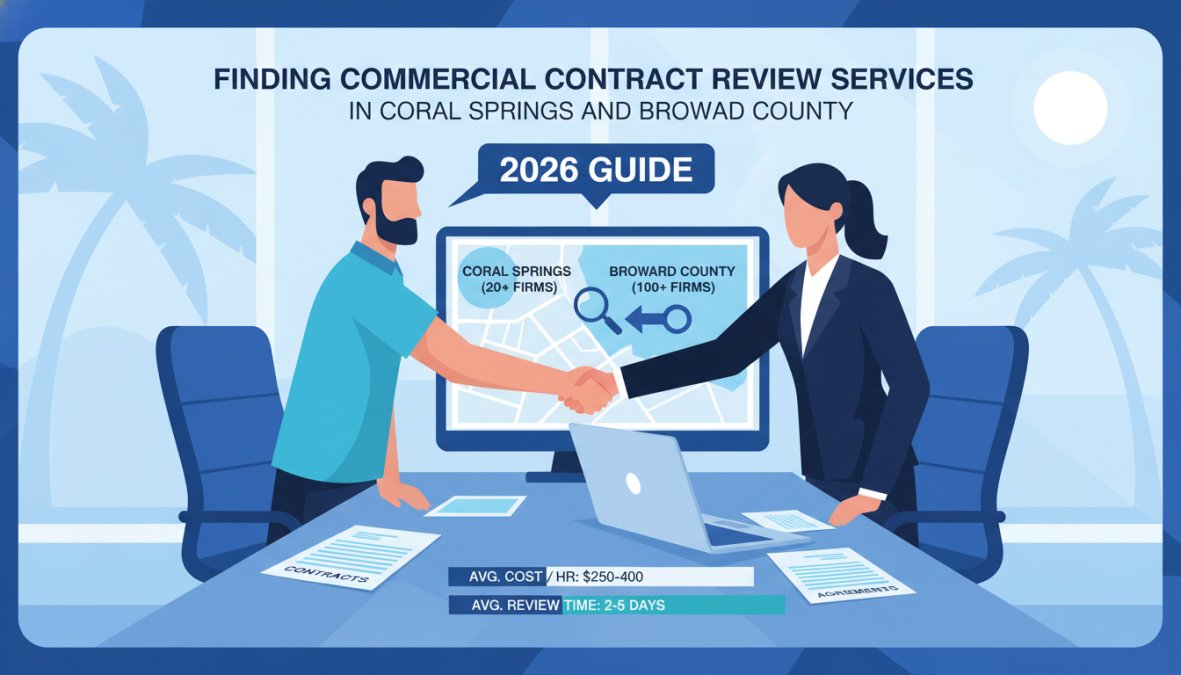
Finding Commercial Contract Review Services Near Me in Coral Springs and Broward County
Coral Springs and the broader Broward County business community have a range of legal service options, from solo practitioners to regional firms. The challenge is not finding an attorney; it is finding the right one for commercial contract work specifically.
Matthew Fornaro, P.A. has served entrepreneurs and small business owners in Coral Springs, Parkland, and across Broward County for over 20 years. The firm’s focus on business formation, commercial litigation, and contract law means that clients get attorneys who understand both the transactional side of a deal and what happens when a contract ends up in dispute. That dual perspective, transactional and litigation-oriented, is genuinely rare and genuinely valuable.
For businesses searching for commercial contract review services near me in the Coral Springs area, proximity matters for more than convenience. A local attorney understands the South Florida business environment, the local courts, and the specific industries that drive the Broward County economy. That context shapes how they review contracts and what risks they flag.
What to Look for: Board Certification, AV Rating, and Local Experience
Not all attorneys who offer contract review have the same qualifications. Here is what to evaluate when selecting a provider.
Board Certification: The Florida Bar’s board certification program identifies attorneys who have demonstrated expertise in a specific area of law. For business law and commercial litigation, board-certified attorneys have met rigorous standards of experience, peer review, and examination. This is a meaningful credential, not just a marketing label.
AV Rating: The AV Preeminent rating from Martindale-Hubbell is a peer-reviewed credential reflecting the highest standards of legal ability and professional ethics. It requires ratings from fellow attorneys and judges, making it one of the more credible third-party signals of attorney quality.
Local experience: An attorney who has handled commercial litigation in Broward County courts, dealt with Florida-specific regulatory compliance issues, and built relationships with local business owners brings contextual knowledge that a national platform or out-of-state firm cannot replicate.
Free consultation availability: Many reputable business attorneys in Coral Springs offer an initial case evaluation or free consultation. This is your opportunity to assess whether the attorney understands your industry, communicates clearly, and has relevant experience. Use it.
Scope of services: The best contract attorneys can handle the full business lifecycle, from formation through dispute resolution. An attorney who only does transactional work cannot advise you on the litigation implications of the contract language they are reviewing. Look for firms with depth in both areas.
According to the Florida Bar’s attorney search and verification tool, you can verify any Florida attorney’s bar status, board certifications, and disciplinary history before engaging them.
Commercial contracts are where business intentions meet legal reality, and the gap between the two is where disputes are born. Matthew Fornaro, P.A. provides the kind of practical, results-oriented legal representation that Coral Springs and Broward County business owners need: deep experience in both commercial transactions and business litigation, genuine local knowledge, and a focus on protecting your business interests at every stage of the lifecycle. Call Matthew Fornaro, P.A. today to schedule a consultation and get a clear-eyed review of what your contracts are actually committing you to.
Frequently Asked Questions
Why is professional commercial contract review important for small businesses?
Commercial contract review services near me provide more than a read-through, a qualified attorney identifies unfavorable liability clauses, missing indemnification protections, unenforceable terms under Florida law, and ambiguous language that could trigger contract disputes or commercial litigation. For small businesses and entrepreneurs, one overlooked clause can expose personal assets or void an agreement entirely. Professional legal review is one of the most cost-effective forms of asset protection available.
What should I look for when hiring a contract lawyer near me?
Look for a transactional attorney with demonstrated experience in business transactions and contract law specific to Florida. Board Certified specialists recognized by the Florida Bar signal a higher level of verified expertise. An AV Rated attorney indicates strong peer recognition for professionalism. Also confirm the firm offers a free consultation, has local knowledge of Broward County regulations, and can clearly explain their fee structure upfront before you commit.
How much do commercial contract review services typically cost per hour in Florida?
Attorney hourly rates for commercial contract review in Florida generally range from roughly $200 to $500 per hour depending on experience, location, and complexity. Board Certified or highly specialized attorneys tend to sit at the higher end. Many firms also offer flat-fee review packages for straightforward agreements, which can provide better cost predictability. Always ask about fee structures during your free consultation so there are no surprises on your invoice.
Can I review a commercial contract myself instead of hiring a lawyer?
You can read a contract yourself, but DIY review carries real risk. Most commercial contracts include legal terms, indemnification, limitation of liability, jurisdiction clauses, and regulatory compliance language, that are easy to misinterpret without legal training. AI tools can flag obvious issues but cannot provide legal advice tailored to Florida law or your specific business situation. For high-value or long-term agreements, professional legal representation is strongly recommended over self-review.
What are common pitfalls in commercial contracts that businesses overlook?
The most frequently missed issues include vague scope-of-work definitions, one-sided indemnification clauses, automatic renewal terms, inadequate dispute resolution provisions, missing confidentiality protections, and non-compete language that may be unenforceable under Florida statutes. Businesses also frequently overlook force majeure limitations and payment default remedies. A local attorney familiar with Florida contract law and commercial litigation can spot these issues before you sign and negotiate better terms.
This article was written using GrandRanker


